


Today we conclude my chat with Bishop David Motiuk, Eparch of Edmonton about his impressions and thoughts about the 2026 Synod of the UGCC and his visit to the Home of Hope in Lviv.
Please share your greatest impression the Synod? What would you like your faithful to know about the Synod?
Just about the place of this year’s Synod. It was held at the Marian Shrine, Our Lady of Zarvanytsia, that is an age old pilgrimage site. Before the war, 100,000 faithful would gather, this year some 10,000 attended. There is something very special and powerful about this place.
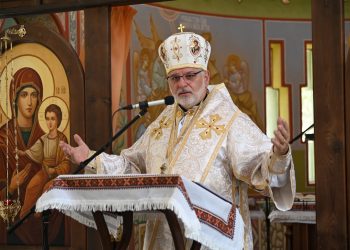
Anticipating the Liturgy for the 25th anniversary of the Bridge of Hope where I was the main celebrant, and was going to preach to the kids, I wanted to say something meaningful, to touch their hearts. I was not feeling well after a long trip and needed a short rest. However, fate prevented a rest but did bring me to a stop at the local parish in Zarvanytsia where I prayer for the assistance of the Mother of God for the tasks ahead, for preaching to the kids that would be attending. It was sort of miraculous because afterwards I felt much better, I felt my prayers were answered and I was able to fulfill my commitments with the guidance of the Mother of God. This confirmed my impression of Zarvanytsia being an exceptionally holy place.
There is something extraordinary about this historic pilgrimage site and the Synod being held under the Omoforion, the protection of the Mother of God during war time, and the whole church gathered to do hard work. Being there with the Mother of God to journey, to guide us, to bring our petitions, our pleas, our prayers, before her Son, this was just a beautiful gift. Yes, we did important things, we were blessed by our brotherhood, shared time and meals, but we were brought together in this most holy site of Zarvanytsia. This is going to be a lasting memory, it is going to carry me through for the time to come.
How would you introduce Zarvanytsia to our faithful?
My brother bishops and I thought it would be wonderful to return post war. As faithful, we go on pilgrimages to Lourdes or the Holy Land. We would organize pilgrimages to Ukraine, to Marian centers where the Mother of God is prominent and draw attention to Zarvanytsia and other places where the Mother of God is working so beautifully, in places of gathering for prayer, for Liturgy, for confessions, for pilgrimage. It would be a wonderful way to bring peoples’ attention, who want to see Ukraine in the beautiful spiritual sense, under the Omophorion of the Mother of God. Maybe that is something, pray God, we could do soon.
Your visit to the Home of Hope was significant. What would you like to share about your visit ? How important is this project for our faithful?
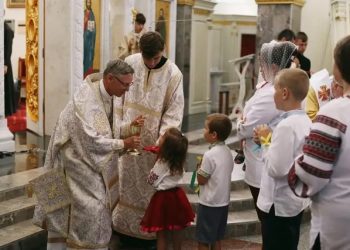
The Edmonton Eparchy, its faithful, supporters, Dobrodiyka Luba Kowalchyk and so many more were celebrating the legacy of the Bridge of Hope between us and orphans and children in need in Ukraine. For 25 years the successes have been under the Bridge of Hope banner in Lviv, where we have the Home of Hope. This is where up to 25 young women, age 18 +, many of whom could be in peril, live together under guidance of the Sisters Servants of Mary Immaculate (SSMI) in a common home, in prayer, those that to want to, share meals, learn skills, and are carrying on studies for a trade or profession. One day they will be on their own.
There are thirteen Bridge of Hope centers in Ukraine we now support. Those are not live-in orphanages. Sisters know families or a mother who has children in need. Unfortunately because of the war, the mother or father may have been killed, wounded, or abandoned their children, some have dependencies. There are all sorts of children in need, not just orphans.
One of the other UCC bishops admired the work of the Bridge of Hope stating that 25 years is a legacy. Some programs do not last. This was very uplifting, this was beautiful.
Sometimes for a 25th we have a liturgy, a banquet, put up a plaque, but that is not me. I have been to the Home of Hope many times over the years and can see the living proof of what our faithful here in the Edmonton Eparchy have been able to accomplish by providing support, prayer and financial aid. Seeing the results is beautiful.
Do you think this is something that could be replicated in other Eparchies?
It already is! The Archeparchy of Winnipeg and Eparch of Saskatoon are involved to varying degrees. This continues to spread and grow throughout Canada, We need to think big. We need to prepare for the day the 20,000 stolen children from Ukraine will return home.
In Lviv, Sister Krystofora, the Provincial Superior, invited me to join in prayers for the funeral of a fallen soldier. She said up to 3 burials occur daily at a nearby cemetery. Every day there are new orphans and children in need. Wouldn’t it be wonderful if our little, but powerful Edmonton Eparchy started a domino effect, or a huge wave, in addition to what is happening in Saskatchewan and Manitoba, and it is embraced and goes viral? In my dreams we could involve CNEWA, already our partner on the ground in Canada and Ukraine. They help so many, primarily eastern Christian churches, that are in need and we could up it a notch, get that kind of fanfare and publicity to the thousands of supporters through CNEWA who would take a glimpse of what we have done in 25 years and journey with us to a whole new level and continue for the next 25 years. There are so many children, they pull at our heart strings.
When need to make an investment in the future of Ukraine, whatever that is going to look like. Now there is a youth drain understandably, so many families have left Ukraine. We can invest in future generations and let them know they do not walk alone, that Christ, through our efforts, our good works, is walking with them. There is hope. The Bridge of Hope can instill hope in the young people of Ukraine who are the future in rebuilding Ukraine on the foundations of faith and Christianity. That would be a dream come true for me.
What can you share about the appointment of the Metropolitan for Canada? Are bishops a competitive group of professionals? What was the selection process like?
We are blessed in the appointment of Bishop Michael Kwiatkowski, from Manitoba, a great friend of mine, a fellow canonist. We first met in Rome, in the early 90’s when we were both working on our doctorates. Our paths have continued to cross. Bishop Michael is someone dear to my heart, very pastoral. He will serve the church well both in his home Archeparchy and throughout Canada, so we were pleased during the Synod when the announcement was made. Of course that journey started a number of years ago in anticipation of Metropolitan Lawrence’s retirement.
We Canadian bishops have been preparing ourselves and our church for future leadership. Succession planning is important in the church like in any other organization. We focused on providing opportunities amongst our clergy for growth in their leadership skills, and observed how they react in different [situations], always the watchful eye amongst the bishops in the midst of our clergy. A year ago the Canadian bishops would have met on numerous occasions and came up with a pastoral episcopal plan to present 3 candidates we felt would be worthy of presentation at the Synod. We provided written profiles, through secrecy, sent questionnaires to clergy, religious and laity who would know the candidates. We summarized the information gathered and presented it to our Canadian bishops who numbered their choices and presented it to the Synod in July 2025 . Then the Synod votes on each candidate whether they are ‘episcopabile’ or worthy to be considered a candidate.
There is a second round of voting, all done by secret ballot, like a conclave and there is no politicking or campaigning. The second vote is to place that candidate for the Metropolia and the synod orders their choices and that is presented to the Holy Father. That was last year at the Dicastery for Eastern Churches.
Then Rome begins their scrutiny of the candidates, then bishops and others receive similar questionnaires and finally they are assembled and presented for appointment by the Holy Father.
Early in the Synod, the Patriarch reviews with all the bishops what our needs are around the world. We receive files on each of the candidates, spend several days reading the materials, in prayer, chatting with one another and only at the end of the Synod do we vote. We are voting on something that is very holy, it is not an everyday matter. We take our time in prayer asking the Holy Spirit to guide us. During our sessions, there is always the Gospel, that is prominent, it is the center of our tables with a lighted candle reminding us of the Word of God, the living Christ through the Gospel, always guiding our decisions. This is not mundane, this is one of the greatest responsibilities the Synod carries and is lightened by the Hole Spirit.
When we send the questionnaires on candidates, the laity are involved in the process. This is a huge innovation of the church in more recent times. I believe half of them would be sent to lay members. This provides great hope for me and others, that walking together, we see things in a very different light, different avenue and different focus which the church now recognizes and takes into account even in the selectin of the bishops process.
Lidia M. Wasylyn
League of Ukrainian Canadian Women National Executive
Photo: RISU