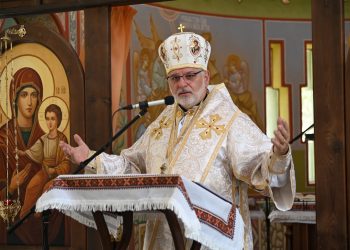



 Today we continue my chat with Bishop David Motiuk, Eparch of Edmonton about his impressions and thoughts about the 2026 Synod of the UGCC and his visit to the Home of Hope in Lviv.
What is the greatest issue for Synod as a whole at this time?
In my opinion, preparing for the future of our church worldwide and in the selection of bishops is a huge challenge. The process of having a bishop appointed is very slow, complex and can take years. Succession planning is as important to our church as it is to any organization.
It took over three years to have a replacement appointed for the late Bishop Stephen Chmilar for the Toronto Eparchy. When Bishop Bayda was appointed for the Eparchy of Saskatoon as he was also appointed Apostolic Administrator of Toronto, several provinces over.
Similarly, when Bishop Ken Novakowsky was appointed to the Eparchy of London, Great Britain, he was Bishop for New Westminster, BC. Then I served as the Apostolic Administrator in his place for four years. Now that Bishop Michael Kwiatkowsky of New Westminster has been appointed Archbishop & Metropolitan for the Archeparchy of Winnipeg, the Eparchy of New Westminster will again be fatherless. The Synod has just met so we will not address the appointment of a new bishop for another year. The challenge is then how to work around that.
As present, it is only at an annual Synod, where our bishops meet in person, can episcopal vacancies be addressed. In comparison, when the Pope dies, cardinals are immediately called to Rome, and within a matter of weeks, they elect a new Pope. Similarly, our Synod would gather to elect the Patriarch. I wonder what is flawed in our process? Is there a better way to address vacancies? Why do the faithful have to wait so long? New Westminster will have to wait at least a year, until our bishops gather again.
In my opinion, this is not healthy to wait. France waited seven years for the appointment of a bishop just this year. The structure and appointment process are huge concerns for me. Additionally, the number of episcopal candidates is shrinking. In Canada most of our clergy are married. Praise God we have gotten over that hurdle, where there had been a prohibition against married clergy for decades. That created huge pastoral challenges for our faithful.
We need to find solutions to both problems, first searching for episcopal candidates and second improving the nomination process. The Synod feels we need to be physically present to conduct the review of candidates, for security, secrecy and the voting process. I believe we have to be bold and courageous. We cannot leave an eparchy fatherless for an extended length of time, this is not healthy.
It is concerning to hear there is a shortage of priestly vocations and that then translates into few bishop candidates in the future. How can this be addressed?
The Eparchy of Edmonton is a bit of an oddity when it comes to priestly candidates. I have been bishop for nineteen years in Edmonton and Auxiliary Bishop for the Archeparchy of Winnipeg for four, and we have not needed to receive priests from Ukraine during those years. That is not the case in other eparchies. Many of our bishops in Canada and the U.S. rely on priests from Ukraine. We have been blessed with a number of local priestly vocations. Due to the war we now have six priests from Ukraine living in the Eparchy, but I am unable to appointed them to parishes because we have a sufficient number of clergy. These priests are able to serve and celebrate Liturgy on Sundays but are not appointed as pastors. They but they have their day jobs. Five of our own eparchial priests serve elsewhere because we have an abundance of clergy.
How unified are our bishops in dealing with the challenges you described? Are there different “camps” among our bishops?
I would not say there are ‘camps’ in our church. Issues are addressed at the Synodal level. At the last Synod we dealt with fostering and journeying with candidates for the consecrated life, but how do you make it come alive at the local level is very different. I have never really thought about our Synod in terms of “camps” as you may read about in the RCC.
There are many examples where theological issues were discussed by the Synod. In time, with conscientious communication a consensus could be reached that satisfied the Synod and met the needs of the faithful. The same can be said about theological issues that may have arisen with our brother Ukrainian Orthodox bishops. Communication, genuine understanding and cooperation with a bit of bold thinking, can resolve differences. For example, infant communion. The UCC in North America chose to return to the early practice of the early church, rediscovering our heritage concerning infant communion. We brought this to the Synod, the initial response was not positive. But now all Eastern Christian Churches practice infant communion.
There are opportunities for the local church in U.S. or Canada or Brazil, to address local pastoral issues so our faithful can grow in their faith journey. Questions can be brought to the Synod, then the Synod can decide to bless it, even though it may not be a global issue. There is an opportunity at the local and Synodal level for us to come to a different pastoral stance.
Local traditions can be beautiful. How we sing the Divine Liturgy, the variety of melodies of our prayers and in our liturgies, it is not wrong, it is different, but the unity is there, still celebrating the same Divine Liturgy.
Please follow the conclusion of this chat in the next issue.
Lidia M. Wasylyn
National Executive, League of Ukrainian Canadian Women