


Ukrainian Parishes Respond to a Changing Community
As Canada’s Ukrainian community continues to evolve in the wake of Russia’s full-scale invasion of Ukraine, Ukrainian Catholic parishes are experiencing both renewal and new challenges. The arrival of hundreds of thousands of Ukrainians has brought new families, new perspectives and new needs to communities already working to preserve their faith, culture and sense of connection to Ukraine.
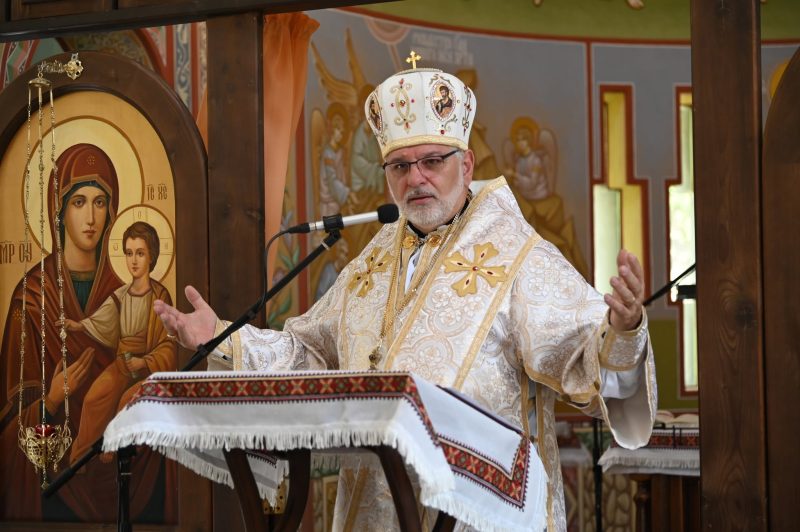
For Bishop Brian Bayda, Eparch of the Eparchy of Toronto and Eastern Canada, the task extends beyond providing a place of worship. Parishes have increasingly become places not only offering spiritual support, but also practical assistance, community and hope to those rebuilding their lives while carrying the trauma of war and separation. Homin Ukrainy – Ukrainian Echo recently spoke with Bishop Bayda about the changing needs of the Ukrainian community in Canada, his recent visit to Ukraine, the role of the Church in supporting families and newcomers, and how parishioners can become more actively involved. He also shared his vision for the Eparchy’s upcoming Bishops’ Dinner and the future of the Ukrainian Catholic Church in Canada.
A Community Transformed
Over the past four years, the Ukrainian community in Canada has changed significantly with a new wave of arrivals. What changes have you observed in our parishes, and how has the Eparchy adapted its pastoral work—both spiritually and practically—to support newcomers rebuilding their lives under the weight of war and separation?
It is difficult to obtain precise statistics, but over the past four years, Ukrainian Catholic parishes across Canada, including those in the Eparchy of Toronto and Eastern Canada, have experienced both renewed attendance and significant new challenges.
Hundreds of thousands of Ukrainians have arrived in Canada and are adapting to life in a new country, often with limited resources and support networks. Approximately 300,000 Ukrainians are believed to have arrived through the Canada-Ukraine Authorization for Emergency Travel (CUAET), with many settling in the Greater Toronto Area. Canadians, both Ukrainian and non-Ukrainian, have responded generously to this new wave of arrivals.
Not all newcomers are Ukrainian Catholic or regular churchgoers. They come from Catholic, Orthodox and Protestant backgrounds and from different regions of Ukraine, each with its own cultural and religious traditions. Many are women and children separated from family members who remain in Ukraine. They are carrying the trauma of war, grief, uncertainty and concerns about their future in Canada.
As a result, parishes have become more than places of worship. They have increasingly served as centres of community, cultural continuity and practical support, helping newcomers connect with housing, employment, language classes, schools, healthcare and other settlement services. At the same time, the needs are complex. Some newcomers arrive ready to establish independent lives, while others require more guidance and support as they navigate a new country. Parishes are also responding to the emotional and psychological effects of war and displacement, while facing practical pressures related to housing, credential recognition and mental health support.
You asked how the Eparchy of Toronto adapted. Well, I was installed as Eparch in 2022, just as the full-scale invasion and the wave of arrivals accelerated. Many deeply care about our brothers and sisters in Christ. We have tried to respond both spiritually and practically, often in partnership with the wider Catholic community and Ukrainian Canadian organizations.
Practical adaptations have included close collaboration with the Archdiocese of Toronto’s Office for Refugees (ORAT). This involved discussions on parishioner-sponsored family programs, hosting initiatives and joint support. A concrete example is the late-2025 donation of more than $60,000 from the Archdiocese to St. Josaphat’s Ukrainian Catholic School, specifically for CUAET students and families.
Parishes have organized or assisted in various ways with donation drives, meal programs, resource referrals, orientation assistance and connections to settlement services, including housing, English classes, employment, school enrollment and healthcare navigation. Ukrainian Canadian organizations such as the Ukrainian Canadian Congress, Ukrainian Canadian Social Services and CUIAS have produced and updated newcomers’ resource guides and provided settlement support; churches frequently serve as entry points or informal partners in these efforts.
Spiritual and pastoral adaptations emphasize accompaniment amid trauma and separation. The Ukrainian Greek Catholic Church’s Synod of Bishops has inspired many and, in turn, has been inspired by many very generous people whom I would refer to as “Missionary Disciples” of Christ. They have established priorities and developed initiatives highlighted in pastoral renewal discussions. They have stressed the importance of healing wounds and trauma, providing practical attention to the poor and marginalized, supporting families under wartime stress and sustaining hope. Parishes have offered a spiritual home that includes prayer for Ukraine and for those who are suffering.
Additionally, my role heading the UGCC Patriarchal Commission for Youth Ministry has reinforced attention to younger generations affected by displacement. My Chancery staff, my clergy and the schools where they serve as chaplains are very proactive and supportive.
We have been focusing our efforts on families. Every individual is shaped and nurtured by their family. When smaller families are traumatized, the needs of the individuals within them must be met by other families. Consequently, we are dedicating our efforts and resources to establishing a Family and Life Office in the Eparchy.
The overall stance has been missionary as well as pastoral: serving not only established faithful but also newcomers who may not previously have been active churchgoers, while seeking to hold together the “old” and the “new” within one community.
People in our churches continue to navigate the balance between cultural preservation, practical solidarity and the deeper spiritual work of presence, healing and hope.
In short, the Eparchy and its parishes have moved from an emergency welcome toward longer-term accompaniment—spiritually through liturgy, prayer and pastoral care, and practically through partnerships, school support, settlement referrals and community networks.
Visiting Ukraine
What did you observe during your visit to Ukraine, and what encounter stayed with you most strongly?
That is like asking me to say what I saw last night in a sky full of stars. It is hard to single out one encounter with God that shines in the darkness above the rest. What might be the criteria for that?
Is it the continued mutual support among the people I have often texted every week since we met? Is it a photo in my heart of an orphan reaching out to me for a hug? Is it the radiance of a face as I step off a train after a journey lasting 12 hours? Is it the dignity of a person bearing their soul to Christ and, through me, asking for forgiveness in confession?
Is it a smile of victory on the face of a child who has not laughed for months after they expose the truth behind my feeble magic trick? Or is it the walk “home”—to the new place where I will finally rest my head for the evening—as my recollection of an evening of storytelling gently reveals to me my Ukrainian identity and heritage?
After spending time with people in Ukraine, did the experience change or deepen your sense of the role the Ukrainian Catholic community in Canada can play in supporting the Church and people of Ukraine?
Indeed, spending time with people in Ukraine did deepen my sense of the role the Ukrainian Catholic community in Canada can play in supporting the Church and people in Ukraine.
The needs are countless in Ukraine. Equally, their gifts to us are countless as we discover their dignity, endurance and hope in Christ, which never disappoints. The spiritual, material and social resources that we can offer actually help direct our attention to the deeper needs that we also have, such as recognizing our need for a spirit of gratitude and appreciation for all that God has given us.
We become aware of so much more that God wants to give us through the humility of others and our mutual charity.
From Intention to Action
Many parishioners feel a strong desire to help Ukraine and their fellow Ukrainians. What opportunities does the Eparchy offer for those who want to become actively involved?
Volunteer your time, your talents and your treasure. Simply put, love your neighbour as yourself.
Investigate the many efforts our parishes have initiated to respond to others in their time of need. Read the bulletins with an eager eye to help. Search your heart to see how you can help, or suggest what you can volunteer or gift to our Family and Life Centre.
Make it a topic of your personal prayer and conversation. Ask a friend, “I was wondering how I might respond more to the crisis in Ukraine and here in Canada because of the war?”
Watch where the simple conversation over coffee will go and what the Holy Spirit places on your heart. Then take action, commit to further discernment and spread the word through your actions.
Call the parish office and ask how you can deepen your love and act on your potential to help.
What would you say to someone who feels their contribution may be too small to make a difference?
Ask anyone who has been helped by someone else what it means. Every small action done with love is important. Jesus reminds us, “Whatever you did to the least of these, you did to me.”
Don’t give into the temptation from the evil one that your contribution of time, talent or treasure will not make a difference.
The Eparchy is preparing for its second Bishops’ Dinner on October 15, 2026. Could you tell us about the mission of this year’s event and what you hope it will accomplish?
Our theme is “Serve One Another as Good Stewards of God.” Based on Scripture and the recent invitation from the Synod of Bishops of the UGCC, we wish to continue emphasizing the importance of guests becoming, or continuing to be, good stewards of God’s gifts, while giving them an opportunity to strengthen families, since families form and nurture vocations.
More specifically, we want to develop and support families here in Canada and those from Ukraine through:
- Formation and Education, focused on the spiritual formation and catechesis of children, teens and schools;
- Responding to Pastoral Needs, focused on family accompaniment and marriage preparation; and
- Outreach, through programs for families, evangelization, pro-life events and witness by developing media materials and proclaiming pro-family bioethics and policies.
A Future Built on Stewardship
As our community continues to grow and change, what gives you the greatest hope for the future of the Ukrainian Catholic Church in Canada—and what would you say to parishioners looking for ways to strengthen our Church and support Ukraine?
Listen to the voice of God in your heart. Act on your intuition and your thoughts. Put into action the fruit of your awareness of needs and how to respond to them.
The conversations you have and the ideas that come to you should be shared with others. Trust God. You have been given gifts. Be good stewards of those gifts.
What He has placed on your heart is not beyond your means of time and talent. Share the idea, refine how it can be implemented and give of yourself.
“Serve One Another as Good Stewards of God.”
Nadia Gereliouk