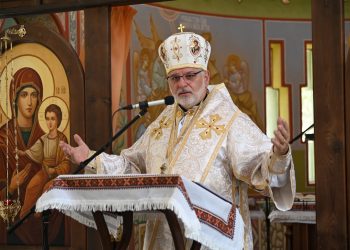



His Grace Bishop David Motiuk, Eparch of Edmonton attended the 2026 Synod of the Ukrainian Greek-Catholic Church(UGCC) in Zarvanytsia, Ukraine in July, 2026. I had the privilege of chatting with Bishop David about his Synod experience, the process of electing a new Metropolitan and his visit to the Home of Hope in Lviv, Ukraine, marking 25 years of this project. In the next three weeks we share Bishop David’s impressions and thoughts.
The word “Synod,” from the Greek synodos means coming together, meeting for collective discernment and decision making within the church. What aspects of “Synod” are unique in our eastern catholic understanding?
In the Roman Catholic Church(RCC) there is a direct connection to the Pope. In the Eastern Catholic Church we also recognize the Holy Father as the successor to St. Peter, but there are intermediary structures, synodality is expressed through the local bishop, then through the Metropolitan and then through the Patriarchical structure. The Ukrainian Greek Catholic Church (UGCC) is a worldwide church that unifies us in our history, in a common people, in liturgy, in spirituality, in theology and canonical law. This is quite different from the RCC, the Protestant and Anglican churches.
When bishops meet, are there security issues? How is your personal security maintained especially when the entire leadership of our church is together during this time of war?
This was the second time the Synod met in Ukraine. It was quite different from last year when we met in Rome with Pope Leo. The year before last when we met in Ukraine, we had a stationed military presence, armed vehicle, fighter jets heard launching. A Kyiv children’s hospital was bombed, there were incoming missiles, jets moved around, we heard it all, especially at night.
This year was different, it was calm. Zarvanytsia is a very holy place. In my opinion it is a small target. There are other higher priority targets unfortunately, the aggressor is targeting, but Zarvanytsia is not. So we saw a big deescalation of the military presence for our protection.
We know russia has targeted churches, temples and synagogues, in my mind, deliberately. As documented by “60 Minutes” a few years ago, hundreds of churches and religious buildings have been targeted. In some towns or villages they were only points targeted. There was nothing else touched so it was a deliberate attempt because the church speaks as a voice throughout the world.
We are mindful that, our entire church leadership is under the same roof. We come together under the grace of the Holy Spirit and we pray. The Holy Spirit is our protector.
How many bishops attended other than Bishops emeriti?
This was the largest gathering of UGC Bishops historically, fifty of us, all active bishops. Retired Bishops do attend but their presence is not required. That is one of our strengths and one of my personal joys. We come together from a wide variety of backgrounds, representing Australia, Argentina, Brazil, North America, England, France, Germany, Italy, wherever we have a somewhat established church structure. We have a common faith and liturgy, common pastoral concerns, it is wonderful. This was my 24th Synod, it is the fraternity, the time in prayer, at meals, time spent together, that gives me strength.
What is it like being part of the brotherhood of bishops, all different and scholarly?
It is certainly a graced experience being together. Some bishops are retiring, others are in the height of their ministry, and you have young bishops attending a Synod for the first time. I think they quickly realize we all belong to one family and we all move in the same direction. We all love the church and our faithful, we strive to make the best decisions, so the gospel can be implanted in our hearts and thrive. It is amazing for young bishops to see this and be part of something bigger than themselves.
When we go home, we cannot personally talk to other bishops, so it can be challenging. Matters come across our paths daily and all of us struggle, our pastors, our faithful and we try to respond. When fellow bishops have similar experiences, you gather, share and carry that load together. It really is a grace moment.
Оur bishops are of one church, however due to geography and backgrounds, everyone has their own journey. What are some of the issues they facе?
Let me explain by example. Bishop Stepan Sus is an Auxiliary Bishop in Kyiv with Patriarch Sviatoslav, but his portfolio is to journey with our faithful where there is no bishop nor eparchy established, as in Spain or Portugal. Our UGCC faithful are not under a Ukrainian Catholic Bishop, they are under the local Roman Catholic Bishop. It has been challenging to organize our faithful and respond to the needs prior to the war but especially during the war, especially as we are talking about tens of thousands of faithful. The difficult challenges are to provide spiritual support, organize many parishes, wherever the faithful are, to find priests to celebrate the Divine Liturgy, to finance church, expenses. Most RC parishes do not charge anything or very little for renting their churches to our faithful. Sometimes the RC churches are empty because parishioners have gone elsewhere or numbers have dwindled.
In Canada we have a beautiful working relationship with our Latin counterparts. Metropolitan Lawrence has until now been an Ex Officio member of the Permanent Council that meets in between the annual meetings of the Canadian Council of Canadian Bishops. I served four years, as president of the western bishops-B.C., Manitoba, Alberta and the North. Metropolitan Maxim Hermaniuk was a huge statemen representing our church in the face of the RCC locally. That relationship is not always mirrored elsewhere, so there are great challenges in working toward the appointment of a Ukrainian Catholic Bishop in new areas where we do not have that structure, like in Spain and Portugal.
Currently, the challenge is that in order to have a bishop appointed outside of the jurisdiction of the local eparchy, intervention of Rome and the Pope is required. We continue to impress on the Holy Father there is a great need to establish structures, parishes, assign priests and a bishop for our faithful. The Pope has chosen to work, as has been done in the past, and for years in Canada and the US, through the local RC bishop.
Blessings and challenges come with that. The danger is if wait too long then there is the risk of repeating the past, especially like in the U.S., in the early part of the 20th century. At that time there was the issue of married priests and this led to misunderstandings with Rome. We could not have married clergy, yet the vast majority of our priests from Ukraine were married. That put a real strangle hold on our church to have priests that could serve our community. This is a challenge for our Synod today. We must continue to be good advocates for our faithful and avoid any historic problems.
There is a centuries old ecclesiastic principal, one I do not uphold, but some believe, Eastern Catholic Churches developed in certain nations, among certain peoples and some still say our [church’s] mission is to serve only Ukrainian Catholics. Many non-Ukrainian have found their way to our church, through marriage or they love the Liturgy, there is the freedom to choose. In that old principle, the world is divided into RC territory, such as Canada and Ukrainian Catholics — Ukraine. We recognize that Ukrainian Catholics live outside Ukraine.
Some years ago the Papal Nuncio for Canada whom I was chatting with expressed that Canada’s ecclesiastical jurisdiction is the RCC. I responded that there is a nuance to that, there is enough work for all of us to evangelize. Canada was a huge Christian country founded on Christian values, not so much today. I do not think it is a question that my ministry is restricted to Ukrainian Catholics and that the ministry of the RCC is to reach out to all peoples. This is a remnant, I believe, of a false perception that the Latin Church is the pristine church and the rest of us have a little bit of ministries to perform. That is challenging in places like Portugal and Spain, where the old principal is still held by some, not all and not by the majority. This is the right and the obligation that Christ entrusts to all bishops and of course all the laity, that journey of walking together.
This view is not held nor shared by all RC bishops in Canada This is a privileged country and the opportunity for evangelization is shared by all RC and Eastern Catholic bishops. We understand that and support each other, but that is not the case everywhere in the world.
Lidia M. Wasylyn
League of Ukrainian Canadian Women, National Executive