



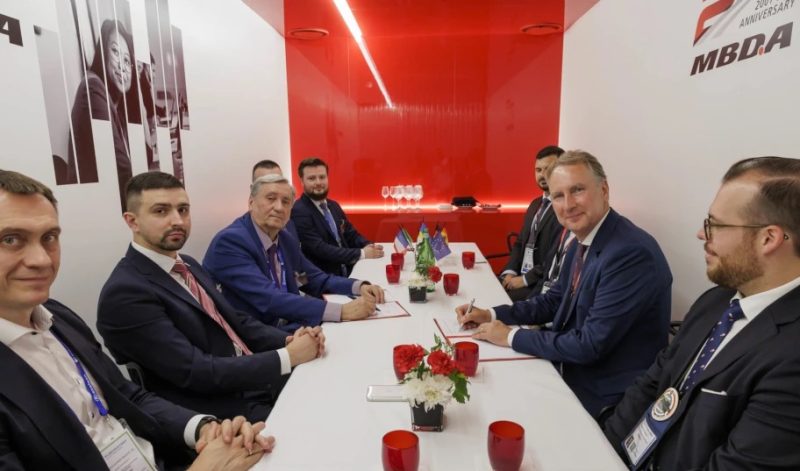
The Ukrainian missile program is officially entering a global European level, opening a new chapter in its modern history. At the prestigious international exhibition Eurosatory in Paris, the European defence giant MBDA signed a memorandum of understanding with the Ukrainian state-owned Kyiv Design Bureau “Luch”. The main goal of this strategic agreement is the joint development, modernization, and subsequent serial production of the next-generation cruise missile “Neptune-2”.
This step marks a fundamental shift in military-technical cooperation between Ukraine and the West. Instead of the usual supply of ready-made foreign weapons, the parties are moving toward deep technological integration and the joint design of long-range weapons. The new missile is being developed to provide the Armed Forces of Ukraine with unprecedented capabilities for high-precision deep strikes against strategic enemy targets at long distances.
The history of the “Neptune” missile family began with the R-360 anti-ship complex, developed by the “Luch” Design Bureau in record time. This weapon gained worldwide recognition in April 2022, when two precise strikes sank the flagship of the Russian Black Sea Fleet, the missile cruiser Moskva, proving the high efficiency of Ukrainian engineering even under tight constraints and resource deficits.
However, the challenges of full-scale war demanded a rapid evolution of the weapon. Ukrainian designers quickly adapted the “Neptune” to strike land targets by changing the guidance system and increasing its operational range. Subsequently, a modification known as “Long Neptune” appeared, capable of travelling up to 1,000 kilometres with a payload weighing 260 kilograms.
The agreement with MBDA opens completely new horizons for this project. “Neptune-2” will not simply be another cosmetic modification of post-Soviet heritage. It will be a fundamentally new technological product built to the strictest Western standards, combining Ukraine’s unique combat experience with the advanced industrial power of a united Europe.
The MBDA consortium is the absolute leader in the European missile systems market. This company produces legendary cruise missiles such as Storm Shadow/SCALP, which have already demonstrated surgical precision on the battlefield in Ukraine, as well as the German-Swedish Taurus missiles and Aster long-range air defence systems. Involving such a giant in cooperation with “Luch” will solve several critical tasks for the Ukrainian defence-industrial complex.
First, it enables the integration of advanced guidance and navigation systems. Modern warfare is a clash of electronic warfare (EW) technologies. Russian jamming systems often complicate GPS satellite navigation. MBDA possesses unique autonomous guidance technologies, such as terrain contour matching navigation systems (TERPROM) and imaging infrared homing heads (DSMAC) that compare the target image with an onboard database right before the strike. This will make “Neptune-2” practically invulnerable to enemy interference and electronic suppression.
Second, the alliance with a European manufacturer provides Ukraine with access to stable component supply chains. The domestic production of long-range missiles was constrained for a long time by a shortage of specific microelectronics and high-tech components. Thanks to MBDA, “Neptune-2” will receive a reliable, Western-style component base, enabling the scaling up of production from piece-by-piece assembly to mass-serial production.
The agreement between MBDA and “Luch” holds significant geopolitical weight. For a long time, Western partners refrained from providing Ukraine with long-range weapons due to fears of escalation or banned their use against targets inside the Russian Federation. The joint development of the “Neptune-2” missile completely removes these political restrictions. Because the missile is officially a Ukrainian development, the right to use it belongs exclusively to Kyiv, giving the Ukrainian Armed Forces a legitimate and exceptionally powerful long-range deterrent.
Furthermore, signing the memorandum at the Eurosatory exhibition demonstrates the European defence sector’s high level of trust in Ukrainian enterprises. Ukraine is no longer viewed merely as a recipient of aid; it is becoming an equal partner with invaluable experience in high-intensity warfare. During the signing ceremony, the CEO of MBDA emphasized that the company aims to implement “groundbreaking innovations” alongside their Ukrainian colleagues. This indicates that Europeans are also interested in Ukrainian expertise in rapidly adapting civilian technologies for military needs and testing systems in real combat conditions.
The joint creation of the “Neptune-2” missile lays a solid foundation for Ukraine’s future integration into the European security architecture and NATO’s defence industry. Modernizing Ukraine’s missile potential with support from a European giant will not only significantly boost its defence capabilities but also strengthen the European Union’s eastern flank.
The “Neptune-2” project proves that the Ukrainian defence-industrial complex is being revived on a new, more technologically advanced foundation. Combining the courage and engineering ingenuity of the “Luch” Design Bureau with the industrial might and technologies of MBDA can create a weapon that will alter the regional balance of power and ensure the reliable protection of state sovereignty for decades to come.
Oleksandra Chorna