


Bill Hall, Kingston Whig-Standard, 15 June 2026
More than half a century after it began, Kingston’s Lviv, Ukraine Folklore Festival is drawing packed crowds once again — not only as a celebration of culture but as a reflection of a community reshaped by war and migration.
The annual event, hosted by the Ukrainian Canadian Club of Kingston, marked its 57th year this weekend, making it one of the longest-running Ukrainian cultural festivals in the country. The two-day festival features Ukrainian cuisine, cultural exhibits, crafts and live performances, drawing visitors from across eastern Ontario.
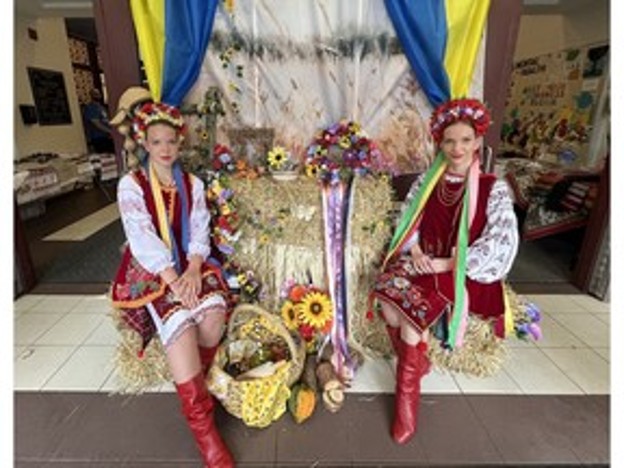
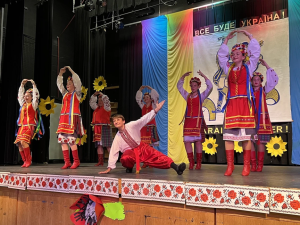
Inside Regiopolis-Notre Dame Catholic High School, the air was filled with music, the smell of freshly prepared perogies and cabbage rolls, and the sound of applause as dancers in embroidered costumes took to the stage.
“It’s the only pavilion that’s still here after 57 years,” said Lubomyr Luciuk, president of the Ukrainian Canadian Club of Kingston and a retired professor at the Royal Military College of Canada. “So, we are actually one of Canada’s consecutive, longest-running Ukrainian Canadian folk festivals.”
For Luciuk, the festival is both a public celebration and a personal one. He attended the first edition as a child and has watched it grow alongside Ukraine’s emergence on the global stage.
“In those days, people used to ask, ‘What is Ukraine? Where is Ukraine?’” he said. “Of course, much has changed.”
Ukraine’s independence in 1991 and the ongoing war with Russia — which expanded dramatically in 2022 — have brought the country into sharper international focus and contributed to a new wave of immigration to Canada.
Luciuk said those newcomers have revitalized Kingston’s Ukrainian community.
“This last wave … particularly after 2022 … they are political,” he said. “They have infused a new dynamic quality into our community.”
Many have become involved in the festival as performers and volunteers, continuing traditions begun by earlier generations of immigrants, including post-Second World War refugees like Luciuk’s parents.
“It’s just this nice sense of continuity,” he said.
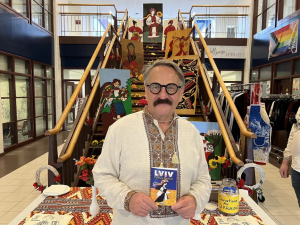
That continuity was on display Saturday, when several political leaders attended the festival, underscoring its significance in the community. Kingston Mayor Bryan Paterson, Kingston and the Islands Member of Parliament Mark Gerretsen and Kingston and the Islands Member of Provincial Parliament Ted Hsu were among those present on Saturday. They were joined by Ukraine’s ambassador to Canada, members of his delegation and a young Ukrainian military officer currently training in Kingston.
The officer, dressed in uniform, addressed the crowd and thanked the city for its support.
“He thanked Kingston for giving him a home away from home,” Luciuk said. “He got a standing ovation.”
Luciuk described the moment as deeply moving, particularly for younger attendees who later gathered around the officer to ask questions about his work in electronic warfare and his experiences in the conflict.
“He kept saying he was so grateful,” Luciuk said. “And he said, ‘We will win the war, and we will never forget what Kingston and Canada did for us.’”
For many in attendance, the festival’s connection to current events was personal.
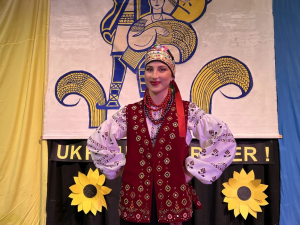
Barbara Shpachnyska, a Grade 12 student at Regiopolis-Notre Dame, arrived in Kingston from Kyiv three and a half years ago as the war intensified. She said attending the festival helped her feel at home during a difficult transition.
“The first time I found out about the Ukrainian folklore festival, I felt like home,” she said. “Everything was designed as Ukraine, and the food was like home.”
At the time, she was struggling to adjust.
“When I arrived, everything was new — the language was new — and I was so lost,” she said.
She said adapting to Canadian culture, particularly as a teenager, was challenging.
“Canadian kids are really different,” she said, noting differences in communication and social behaviour. “I still feel a little bit distant sometimes.”
Over time, she built connections through school and the Ukrainian community but said events like the festival remain essential.
“When I’m dressing up in Ukrainian clothing and I’m dancing … I feel more connected,” she said. “I’m getting that spirit back.”
Her ties to Ukraine remain strong — and deeply emotional.
Her father is still in Ukraine, serving in the military and unable to leave the country.
“He’s fighting right now,” she said. “I really hope I’ll see him again.”
She said communication is limited, but when possible, she shares moments from her life in Kingston — including her performances at the festival.
“If my dad is available, I call him on video and I show him everything,” she said. “He’s so happy to see me in Ukrainian costume in Canada.”
Her immediate hope is simple.
“My wish right now is for the war to end, so I can really enter Ukraine and see all of my relatives,” she said.
In the meantime, she plans to continue building her life in Canada. She is set to graduate later this month and hopes to attend the University of Ottawa to pursue studies in the medical field.
Other newcomers echoed similar experiences.
Yevhenia, who arrived with her daughter four years ago, said they came to Canada with almost nothing.
“We arrived in Belleville without anything — just two bags,” she said. “Then a friend helped us get to Kingston. Many people from Kingston helped us to adapt.”
She found work at Pam’s Flowers and worked there for two years. Then a cleaning job for Homestead Land Holdings was simply a rung on a ladder to administrative work, as she worked hard after hours to learn English.
As Yevhenia built a career, her daughter’s determination on the basketball and volleyball courts at Calvin Park Public School garnered her first-place medals. She begins Grade 9 at Regiopolis-Notre Dame Catholic High School in the fall and is already looking to post-secondary education in fashion design.
“We keep moving forward,” Yevhenia said. “We never give up.”
The blend of tradition and change was evident throughout the weekend festival.
A full schedule of dance performances highlighted Ukrainian folk traditions, while vendors sold handcrafted goods, artwork and, in some cases, products imported directly from Ukraine — something Luciuk said would have been rare decades ago.
He estimated that more than half of the performers are now Ukrainian-born or newly arrived in Canada, reflecting the community’s changing demographics.
Despite Kingston’s relatively small Ukrainian population, the festival continues to attract visitors from across the region, including Ottawa, Toronto and Oshawa.
“It’s just a full program of arts and cultural folk traditions, and everybody seems to have a nice time,” Luciuk said.
Looking ahead, organizers are focused on ensuring the festival’s longevity by passing leadership to the next generation.
“They’ll do things differently, and that’s perfectly fine,” Luciuk said. “But they are very engaged.”