




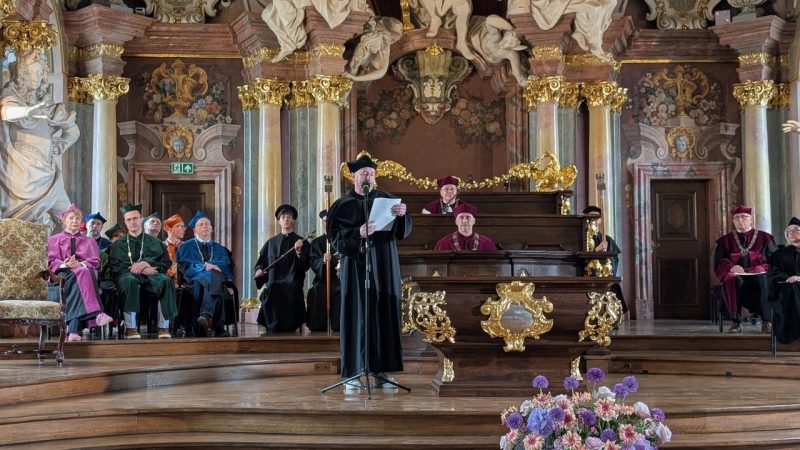
Ukrainian writer, poet, musician, and public intellectual Serhiy Zhadan has been awarded an honorary doctorate by University of Wrocław, one of Poland’s most distinguished academic institutions. During the award ceremony, Zhadan delivered a deeply moving address that resonated far beyond the walls of the university, offering a profound meditation on war, memory, education, justice, and the resilience of the human spirit.
Speaking as both an acclaimed cultural figure and a citizen of a country defending itself against Russia’s full-scale invasion, Zhadan reflected on the devastating realities facing Ukraine’s academic and cultural institutions while affirming the enduring value of knowledge, culture, and hope.
The speech began with a personal recollection. “A long time ago, thirty years ago, I graduated from Hryhorii Skovoroda Pedagogical University. In the summer of 2022, a Russian missile struck the university’s main building. The charred monument to Skovoroda lay in the university courtyard in the middle of a summer day in Kharkiv.”
Zhadan recalled how the image of the fallen philosopher raised painful questions about the meaning of happiness, knowledge, and civilization in a world where residential neighbourhoods can be targeted by missiles. “Do we really have to prove to someone our right to be happy? Is our need for happiness something excessive and unjustified in a world where missile strikes on residential districts are possible? And why are our knowledge, our experience, humanity’s experience, the experience of many generations, unable to protect us from barbarism?”
One of the central themes of Zhadan’s speech was the generation of Ukrainian students whose entire university education has taken place during wartime. He described what lies behind the seemingly simple phrase “studying in wartime”: empty university corridors, professors who have taken up arms, curfews, air raid warnings, and a future disrupted by violence. “Above all, it means broken time, a shifted perspective, a disrupted future.” Yet despite these challenges, Zhadan argued that universities remain among the most important institutions for preserving human dignity and faith in the future. “A university, in my view, is the ideal place where it is appropriate to rely on the past and speak about the future without being afraid of sounding naïve.”
He described education as an act of courage and trust—a commitment by each generation to learn from the past while refusing to turn away from the future. The speech also examined Europe’s failure to fully confront the legacy of twentieth-century totalitarianism and its inability to recognize the dangers posed by modern Russian imperialism. Zhadan warned that evil does not simply disappear with the passage of time. “Evil, as it turns out, is not baggage that can be left in the past. One way or another, we take it with us.”
He argued that unpunished crimes inevitably return in new forms, pointing to the legacy of the Soviet Union and the dangers of historical amnesia. “Leaving evil unpunished means we are destined to face it again.” Zhadan was particularly critical of decades of European complacency toward Moscow’s increasingly aggressive policies. “Having overlooked Chechnya and Georgia, having bargained for far too long with a regime that did not even conceal its revanchist ambitions, whom should Europe blame now, having suddenly discovered beside itself the threat of a new continental war?”
Despite the gravity of these reflections, the speech was not one of despair. Zhadan emphasized that Ukrainians continue to defend not only their own state but also the broader values upon which European civilization is built. “Today, Ukrainians remain between the Russian army and the borders of a united Europe, reminding everyone through their daily resistance where the true borders of Europe lie.” He argued that culture and education, often dismissed as secondary concerns during crise, are among society’s most vulnerable and most essential foundations. “The most defenseless things are often those whose importance is not immediately obvious. Culture. Or education.” For Zhadan, Ukraine’s struggle is ultimately about more than survival. It is about preserving the possibility of a future grounded in freedom, responsibility, and human dignity.
Reflecting on the philosopher Hryhorii Skovoroda, whose damaged monument became a symbol of both destruction and endurance, Zhadan noted:“Skovoroda said that the source of unhappiness is helplessness. Today, helplessness is hardly something that can be attributed to us.” He concluded by reminding the audience that Ukrainian resistance is not defined solely by suffering. “This daily resistance carried out by Ukrainians is not only about pain and despair. It is equally about the strength of those who have the right to be happy—and who have no intention of surrendering that right.”
The honorary doctorate awarded to Serhiy Zhadan recognized not only his extraordinary literary achievements, but also his role as one of the most compelling voices interpreting Ukraine’s experience for the world. His address in Wrocław served as both a warning and an affirmation: a warning about the consequences of forgetting history and tolerating injustice, and an affirmation that even amid war, education, culture, and the pursuit of happiness remain essential acts of human freedom.
Nadia Gereliouk