


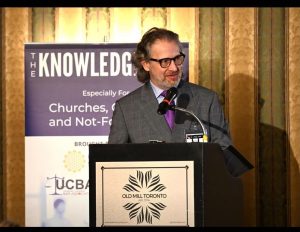
On April 23, 2026, I attended Knowledge Hub 2026 at The Old Mill in Toronto, an event organized by Ukrainian Canadian Bar Association (UCBA), Ukrainian Canadian Professional and Business Association (UCPBA) and Ukrainian Canadian Social Services (UCSS). The event brought together professionals working across the charitable and non-profit sector, including legal, accounting, and advisory practitioners.
The program focused on practical issues currently affecting the sector, with particular attention to regulatory compliance, governance, and the increasing role of technology in organizational operations. One of the more engaging discussions addressed artificial intelligence, not from a theoretical perspective, but in terms of how it is already being used in everyday work. The presentation emphasized that AI systems are fundamentally predictive tools, generating responses based on patterns rather than independent reasoning, and that this has direct implications for reliability and risk management.
The discussion also touched on how AI is being integrated into professional workflows. Practical guidance was offered on how to use these tools effectively, including structured prompting techniques and the importance of setting clear parameters for outputs. At the same time, there was a consistent emphasis on maintaining human oversight. AI can assist with drafting and research, but responsibility for the final product remains with the individual using it. This point was reinforced by reference to recent legal developments confirming that users are accountable for AI-generated content.
Beyond technology, the event addressed broader governance and compliance issues. There was a recognition that charities and non-profits are operating in an environment of increasing regulatory expectations, often while managing limited resources. This creates a need for practical, accessible guidance that aligns legal requirements with day-to-day operations.
The event also provided an opportunity to engage with other professionals in the sector. Informal discussions reflected common challenges, including funding pressures, operational constraints, and the need to adapt to changing legal and technological landscapes. Knowledge Hub consistently attracts a diverse group of attendees, from volunteers and board members to experienced legal and financial advisors, creating a collaborative environment for sharing ideas and experiences. These conversations reinforce the importance of collaboration and information-sharing within the sector.
Overall, Knowledge Hub 2026 once again provided a clear and practical overview of the issues currently shaping the non-profit sector. Each year, the event delivers timely and relevant discussions, reflecting the evolving challenges organizations face. This year, in particular, it highlighted the growing intersection between law, technology, and governance, and the need for organizations to approach these areas in a structured and informed way.
Knowledge Hub continues to establish itself as an important platform within the Ukrainian-Canadian and broader non-profit community, fostering both knowledge-sharing and professional connection.
Ultimately, events like this serve as a reminder that effective non-profit work requires not only commitment, but strong governance, sound legal frameworks, and the ability to adapt to change.
Olha Senyshyn