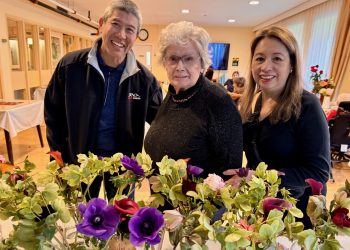



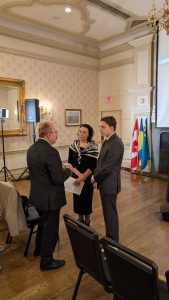
On Saturday, May 9, 2026 members of the Crimean Tatar, Ukrainian, and broader Canadian communities gathered at the Old Mill in Toronto for a solemn commemoration of the 1944 Sürgünlik — the forced deportation of the Crimean Tatar people by the Soviet regime. Organized by the Canadian Association of Crimean Tatars, the evening served both as a memorial to one of the twentieth century’s lesser-known genocides and as a reminder that the struggle for truth, justice, and cultural survival continues today.
Throughout the evening, speakers drew powerful parallels between the Soviet deportation of 1944 and the renewed persecution faced by Crimean Tatars under Russia’s occupation of Crimea since 2014. The event became not only an act of remembrance, but also a declaration of resilience. Among the evening’s most moving remarks were those delivered by Elvira Irsay, Vice President of the Canada Crimea Culture Committee, whose deeply personal testimony transformed history into lived memory.
“Today, I am not standing here only as a speaker,” she told the audience. “I am standing here as a great-granddaughter.” Irsay recounted how her great-grandmother, while her husband was fighting for the Soviet Union during the Second World War, was given just fifteen minutes to prepare before being deported from Crimea. “They gave her 15 minutes,” Irsay recalled. “Fifteen minutes to pack an entire life. Fifteen minutes to become no one.” Her words painted a devastating portrait of the Sürgünlik, the mass deportation launched by Joseph Stalin on May 18, 1944, during which nearly the entire Crimean Tatar population was forcibly exiled to Central Asia in cattle trains under brutal conditions. Tens of thousands perished from starvation, disease, and exhaustion. “This was not relocation. This was not policy,” she said. “This was a crime. A crime against an entire nation.”
Irsay also spoke about the ongoing repression faced by Crimean Tatars since Russia’s occupation of Crimea in 2014, including political imprisonment, displacement, and cultural suppression. “After the occupation of Crimea in 2014, our people once again face the threat of disappearance,” she warned. “A silent, forced displacement is happening again.”
One of the evening’s most emotional moments followed her remarks, as Irsay joined guest musician from Montreal in performing “Ural daghi,” a traditional Crimean Tatar folk song associated with exile and longing for home. Accompanied by the saz (also known as the bağlama), the performance became a poignant tribute to generations who carried memories of Crimea through decades of displacement.
Member of Parliament Yvan Baker, Chair of the Canada–Ukraine Parliamentary Friendship Group, reflected on Canada’s official recognition of the Sürgünlik as genocide, a motion he introduced in Parliament that was adopted unanimously. “The Sürgünlik was a genocide,” Baker stated. “It is important that we be here today to honour the victims, to remember them, and to speak about this atrocity so that history is known.” Baker emphasized that the persecution of Crimean Tatars continues under Russian occupation and stressed the importance of sustained international support for Ukraine. “If Russia wins, it’s not going to stop at Ukraine,” he warned. “NATO will be next.”
Ontario Member of Provincial Parliament Sheref Sabawy praised the resilience of the Crimean Tatar people and emphasized that remembrance must inspire a continued commitment to human rights and dignity. Representing Ukraine diplomatically, Pavlo Latyk, Acting Deputy Consul General of Ukraine in Toronto, underscored the close historical ties between Ukrainians and Crimean Tatars and affirmed that the liberation of Crimea remains essential to Ukraine’s future. Petro Schturyn, President of the Ukrainian Canadian Congress – Toronto Branch, reflected on the growing partnership between the Ukrainian and Crimean Tatar communities in Canada since Russia’s invasion of Crimea in 2014. “We became close friends,” he said. “The Ukrainian Canadian Congress will always continue to support the struggle of the Crimean Tatars.” Orest Steciw, Executive Director of the League of Ukrainian Canadians, similarly emphasized the unity of both peoples in resisting Russian aggression and defending historical truth. A symbolic moment concluded the official ceremony when Borys Mykhaylets, President of the League of Ukrainian Canadians, presented a book on the Holodomor to representatives of the Crimean Tatar association, a gesture underscoring the shared histories of suffering endured by Ukrainians and Crimean Tatars under Soviet rule.
As the evening transitioned into a documentary screening on the history of the Crimean Tatar genocide, one message remained clear: memory itself has become a form of resistance. More than eighty years after the Sürgünlik, the voices of those once forced into silence continue to speak — through testimony, song, solidarity, and the enduring hope that Crimea, and its people, will one day live freely again.
Nadia Gereliouk