




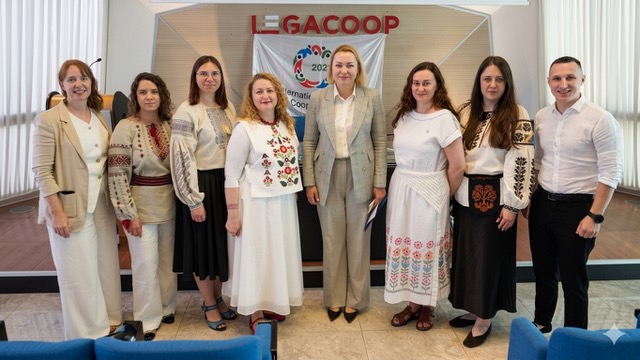
As Ukraine continues to navigate the devastating impacts of war, a major international partnership is laying the groundwork for the country’s long-term economic resilience. At the heart of this effort is the soil, the agri-food sector, and a powerful reliance on community-owned businesses.
Known as The HONOR Project, short for Honouring the Contribution of Rural Women to Ukraine’s Agri-Food Systems, the seven-year initiative represents a $19.5-million investment funded by Global Affairs Canada. Running until 2032, the project aims to stabilize and rebuild Ukraine’s vital agricultural sector by modernizing local co-operatives, improving food security, and driving climate-smart farming.

The initiative is led by SOCODEVI, a famous international co-operative development organization, in tandem with an OISE-led research team at the University of Toronto, working with SOCODEVI and Ukrainian partners. Together with Ukrainian grassroots agencies, they are transforming how humanitarian aid transitions into sustainable, localized economic power. SOCODEVI handles project implementation while OISE contributes the research and training component.
Agriculture has long been the backbone of Ukraine’s economy, but the war has severely fractured supply chains, displaced workers, and damaged infrastructure. The HONOR Project is countering this disruption by reinforcing the co-operative framework.
Unlike traditional corporate models driven by outside investors, co-operatives are owned and operated by the local farmers themselves. Members pool their financial and physical resources, share heavy machinery, make collective business decisions, and divide profits locally.
“Co-operatives are very adept organizations at staying local, improving and stimulating local economies, because the money is produced locally and owned by local people,” explains Dr. Marcelo Vieta, associate professor at OISE and a lead researcher on the project.
Operating across approximately 10 regions in Ukraine, the project expects to impact several thousand people. It is actively strengthening 50 agricultural co-operatives across diverse sectors, including dairy, grain, horticulture, honey, and vegetable production. The long-term objective is to move these communities beyond mere survival and toward competitive operations capable of meeting European Union standards, opening doors to thriving foreign markets.
An integral part of the HONOR Project is its deliberate focus on rural women, who have been forced to shoulder immense burdens as the war restructured civilian life. With a vast portion of the male population serving in the military, women have stepped up to manage family households, run complex farming businesses, and coordinate local humanitarian aid simultaneously.
“Their burden has only increased, and our work is helping to support them,” says Erin Mackie, SOCODEVI’s program director for Ukraine.
To alleviate these pressures, the project provides women farmers with mechanized technology to reduce manual labor, alongside entrepreneurship funding and specialized financial management training. This targeted support is yielding a profound social shift. Rural women are not just sustaining operations; they are stepping into executive boardrooms, leading local governments, and becoming vital advocates for their wider communities.
While SOCODEVI handles the practical infrastructure on the ground alongside local groups like the Rural Women’s Business Network, OISE’s research cohort is capturing the data behind it. Led by Dr. Vieta and OISE alumna Dr. Fiona Duguid, the academic team, comprising Canadian and Ukrainian graduate students, is building a series of case studies documenting how co-operatives are responding to the challenges of war and recovery.
The integration of a formalized research stream represents a new approach to international development in active conflict zones. By documenting how these agricultural networks withstand systemic shocks, the project aims to create a precedent for using co-operatives as tools for post-war recovery.
Halyna Yanyshyn