




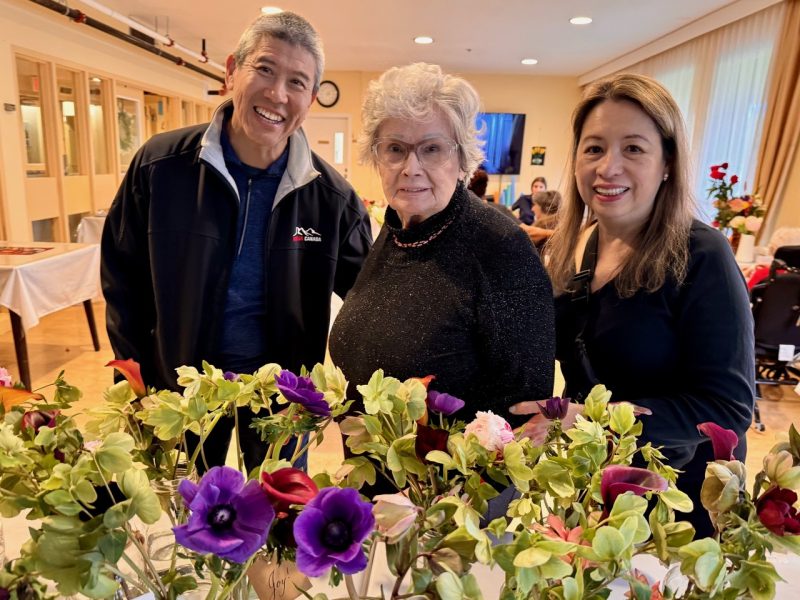
For the Okihiro’s, serving others is not simply an act of kindness. It is a way of life and, as Cris puts it, a way of serving God through the work of her hands. Together with her husband, Randy, Cris regularly visits seniors’ residences across the Greater Toronto Area, bringing flowers, handwritten tags and friendship. Among the places they have visited are the Ivan Franko Homes in Mississauga and Etobicoke, where their unexpected arrivals with armfuls of flowers have become a welcome surprise for residents. At some residences, they have even earned the affectionate nickname the “happy flower people.”
Their visits are simple and personal. There are no speeches, ceremonies or formal announcements. They arrive with flowers, meet residents, shake hands, talk and, for a few moments, brighten someone’s day. For them, that is what service is all about.
“Let the Work of Your Hands Be an Offering”
Cris grew up in the Philippines and describes her childhood as one of humble beginnings. From an early age, she learned to appreciate what she had and to “be grateful with the little.” Growing up with fewer resources also taught her that opportunities sometimes require greater effort. But hard work, good stewardship and a commitment to making a positive difference can change circumstances, not only for oneself, but for others.
A lesson from her then pastor became particularly important to her from her late teens. He encouraged people to let “the work of your hands” be an offering of service to God. Those words has stayed with Cris since. When she feels frustrated, angry or uncertain about what to do, she believes the answer can often (but not always) be found in serving someone else. She also believes that dwelling on what others have, holding on to hurt, or becoming consumed by a sense of unfairness can weigh heavily on the heart. Rather than focusing on what cannot be changed, she chooses to let go, find gratitude in what she has, and focus on things she can work on. “I have heard it said that if anyone gets so angry and seeks revenge – know that the best revenge of them all is to live a good life. I find that in that process of ‘serving’, the idea of anger and revenge quickly disappears and is replaced with empathy, compassion and gratitude.” says Cris.
Cris’ commitment to volunteering began long before her flower visits. After moving from the Philippines (where she was engaged with campaigns for an orphanage) to the United States, she volunteered with Jersey Cares, an organization that, among other initiatives, her favorite was a Salvation Army program where an converted ice-cream truck would drive around and bring food, soup and other necessities to communities in need. She later began volunteering at a hospital, spending three hours each week in the neonatal intensive care unit. Her role was simple but deeply meaningful: holding babies and providing them with warmth and human contact. Eventually, her volunteering expanded to the pediatric oncology department, where she read to children undergoing treatment and spent time with them.
When Cris later moved to Canada, her commitment to service continued. She mentored young people in Missisauga and Rexdale and remained guided by the principles of stewardship, compassion and community service. After she met Randy, they did things together for the community whenever they can in different forms and as of recent years were drawn to give attention particularly at senior homes.
At first, Cris and Randy visited seniors’ residences to see familiar folks. During Thanksgiving and Christmas, they began purchasing extra socks, notepads, small puzzles and other gifts to distribute to residents. But they soon noticed something. During the holidays, many people remember to visit seniors. The rest of the year can be very different. So, in the Spring, Cris and Randy decided to bring flowers. They purchased small bouquets and attached handwritten tags. The response was immediate. Cris later posted in a Facebook group for brides and florists, offering to collect flowers left over from weddings and redistribute them to seniors’ residences. It was a simple idea with a double benefit: flowers that might otherwise be discarded could bring joy to someone else at least for a few more days. They also began purchasing flowers directly from local flower markets and supporting farmers whenever possible. During the summer, they include some flowers from their own backyard whenever possible.
What may look like a simple bouquet represents several days of preparation. Cris and Randy purchase flowers and/or cut them from their garden. They collect mason glass jars from friends and neighbors to use as vases, wash them, remove the labels and prepare handwritten tags. The night before a visit, they fill the jars with a little bit of water, arrange the flowers and prepare everything for the following morning. The visits to the Senior Homes are usually unannounced which adds an element of surprise. But Cris admits that there is always some uncertainty. “You never know what they’re going to ask, or what kind of mood someone will be in, or whether they will want to welcome you.” At the residences, the couple first checks in with administration. Staff members help identify appropriate floors and residents, and someone will often accompany them because they know the residents and can identify allergies or other considerations. Sometimes the flowers are left in the cafeteria so that residents can enjoy them during their meals. The recipients of flowers are not limited to those living in seniors’ residences. Cris and Randy also bring flowers to some seniors in their own neighbourhood.
A Connection to the Ukrainian Community
Their visits to Ivan Franko Homes on Winston Churchill Boulevard in Mississauga have created a particularly meaningful connection. The Okihiro’s were introduced to the residence through Vera, a former neighbour who moved to Ivan Franko Homes.
One resident even once asked them if she can order flowers to be mailed to her daughter for Christmas. She was surprised to learn that the couple doesn’t own a flower shop, and that the bouquets they bring are especially tailored for the residents and not for order or for sale. For Cris and Randy, that small moment captured the meaning behind what they do. Service is not about giving away what is left over. It is about intentionally thinking of another person and choosing to do something for them.
For Randy, service is equally personal. Cris describes him as “the kindest man” and says that serving his family and community comes naturally to him. The couple sees their work not as a project, but as something they do together. Their community involvement extends beyond flower visits. They have supported food banks (Daily Bread), food rescue organization (Second Harvest) and Emergency Disaster Relief (Global Medic), other initiatives, recognizing that even households with one working spouse can struggle to afford rent and basic necessities. They believes that compassion has to lead to action. “You have to be hurt “just enough” to be compelled to act — but not scared to at least try to do things,” she says.
Regularly visiting seniors has also changed the way the couple thinks about aging. “When you go to seniors’ residences regularly, you get to see a semblance of what your future might potentially be,” Cris says. Mobility can change. Circumstances can change. A person’s lifestyle can change. But dignity, connection and the need to feel remembered remain. The visits therefore become a reminder not only to the residents, but also to them, that every stage of life deserves attention and respect.
Cris is also quick to acknowledge that service does not require perfection.“I am only as good because I have made mistakes,” she says. She compares it to her garden: it has become better because she has learned from the plants she lost and the things that did not work. The same, she believes, applies to life. We learn from our many mistakes. We learn from other people. And, perhaps most importantly, we should help the next generation become better than we are. That is a lesson she hopes to pass on to young people. “I want you to be better than me,” she says. Her perspective has also been shaped by different cultures and experiences. She refers to the Japanese concept of shōganai which Randy’s Auntie Hisa used to say, an acceptance that there are certain things in life that cannot be changed. It’s not about defeat, but graceful acceptance of what cannot be changed. We cannot control everything that happens to us. But we can choose how we respond. For Randy and Cris, that response is often gratitude, compassion and service.
Cris says “The older I get, the smaller I feel I become, simply because God becomes greater in my life.” Faith remains at the heart of their approach to life. With age, perspectives change. So do prayers and priorities. Perhaps that is why Cris does not spend much time thinking about how she and Randy will be remembered. “It’s not about monuments. Who cares how I will be remembered? I’d be gone anyway” What matters, instead, is what a person does while they are here, the people they help, the relationships they build and the moments of opportunities and kindness they have created for others along the way regardless if they remember our names or not. For the Okihiro’s, sometimes that legacy is as simple as a flower in a mason jar, accompanied by a handwritten tag.
It may be a bouquet for a resident at a Senior Home, a gift for a neighbour, or volunteering at a local food bank. Small gestures, perhaps, but they are reminders that compassion does not have to be complicated. Service does not require a title, a large organization or a special occasion. Sometimes it begins with a garden, a handshake or a smile.
Nadia Gereliouk