


Myth
In January 1918, the Central Council (Central Rada) dispatched 300 volunteers aged 14 to 17 from the Student Squad (Student Kuren) to face certain death at Kruty. Historian Dmytro Doroshenko described them as “young people, half-children, who had never held weapons in their hands before.”
Truth
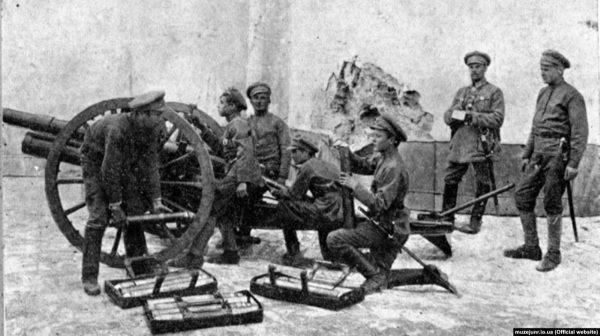
Around 400 cadets took part in the battle near Kruty, comprising of senior officers and cadets from the First Ukrainian Military School named after Bohdan Khmelnytsky, many of whom had prior combat experience (with some having already served in World War I). Additionally, there were fighters from the Death Squad (Kuren Smerti), a volunteer unit formed by soldiers returning from World War I, and experienced free Cossacks from the city of Hlukhiv, who were also older and had combat backgrounds. It was these individuals, rather than inexperienced high school and university students, who made up the primary fighting strength of the defenders at Kruty.
Only 100 members of the Student (Auxiliary) Company of Sichovi Striltsi—between 114 and 130 fighters, depending on the source—made it to Kruty. These members included volunteers from St. Volodymyr’s University, the recently founded Ukrainian People’s University, high school students from the 2nd Ukrainian Gymnasium of the Brotherhood of Cyril and Methodius Bratstvo, and students from other educational institutions in Kyiv. They were positioned in the defense’s safest area, leaving the youngest and those without any shooting experience in reserve.
Twenty senior commanders and over 500 defenders made up the Ukrainian side in the Kruty combat. On a railroad platform, they had a cannon and sixteen machine guns. More than 4,000 fighters, including a detachment of Baltic sailors from Berzin’s 2nd Army and troops of Petrograd and Moscow Red Guards from Yegorov’s 1st Army, were to attack them. Armored trains No. 2 and V. Lenin were to provide artillery and machine gun fire to support the infantry assault. Despite being in Bahmach at the time of the war, Mikhail Muravyov led the assault on Kyiv.
The Ukrainian garrison was thus small for two reasons. The 1st Sichovy Striltsi Hundred, the combat unit of the Chorni Haidamaky of the 2nd Ukrainian Military School, and the Serdyutsky Detachment (zahin) of the P. Doroshenko Regiment (polk)—a total of 500 fighters—were sent to Poltava because the Kyiv Military District headquarters anticipated that the main Bolshevik attack would originate there. Meanwhile, Muravyov launched an offensive in the direction of Bahmach. Second, 300 soldiers from Symon Petliura’s 3rd Haidamaky Regiment were meant to support the Kruty defenders, but they were compelled to withdraw to Kyiv in order to put an end to the Bolshevik revolt at the Arsenal factory.
There was a third reason: the UNR army was in desperate need of both professional soldiers and weapons and ammunition at the time, as it was still being assembled from volunteers from all around the nation. Additionally, several Ukrainianized regiments were transformed from allies into possible foes by Bolshevik propaganda. For example, the Taras Shevchenko Regiment, which was based in Nizhyn and had declared neutrality, could be a threat to the Kruty defenders. As a result, only patriotic Ukrainians—many of whom were young—could be relied upon.
The units at the locations close to Kruty were under the command of Sotnyk Averkyi Honcharenko. As previously stated, soldiers from the Death Squad and cadets from the military school carried out the primary assault. Four platoons of 28 to 30 students each were formed from the student hundred. One squad, made up of younger individuals and those who lacked shooting skills, was kept in reserve and placed between the positions and the station, while three squads took up positions. Units of the Death Squad were also sent to the left flank of their positions in order to support the students.
The battle of Kruty was a fairly successful military operation, despite the enemy’s considerable advantage and the station’s surrender. The Bolsheviks sustained far more casualties than the Ukrainian soldiers over its roughly six-hour duration. The Kruty defenders were only compelled to retreat in a coordinated fashion in the evening, primarily due to a lack of ammunition. Ten officers and perhaps 250 soldiers—mostly young men from the 1st Ukrainian Military School—were killed or injured, according to Honcharenko. As various sources state, between 70 and 100 soldiers were killed, while Bolshevik losses, according to one report, reached 300 people.
The most tragic episode of the Battle of Kruty was the death of a group of students who got lost during their retreat and ended up at a station that had already been occupied by the Bolsheviks. The next day, enraged Red Army soldiers cruelly tortured and then shot all the prisoners with explosive bullets.
But their sacrifice wasn’t in vain: leaving, the Kurtyans dismantled the railway tracks, which delayed Muravyov’s advance on Kyiv for several days. These days proved decisive in the negotiations that were taking place in Brest at the time and made it possible to conclude the Brest Peace Treaty with the countries of the Quadruple Alliance, one of the main points of which was the international recognition of the UNR.
Source: Ukrainian Institute of National Memory (UINM)
Oleksandra Chorna