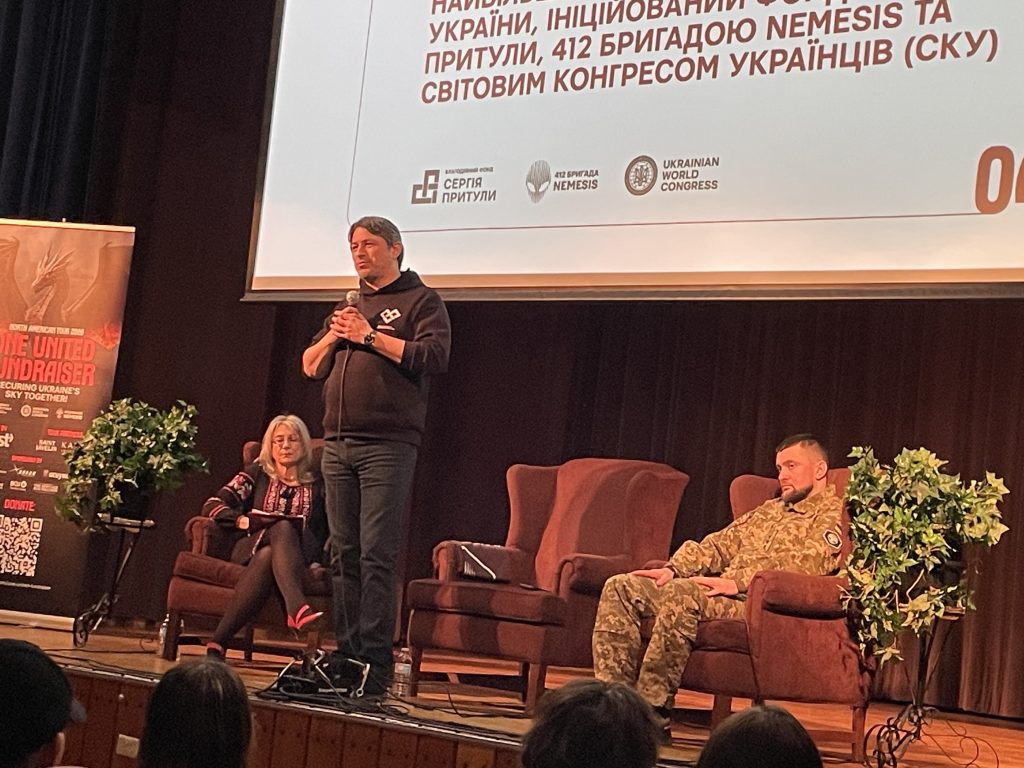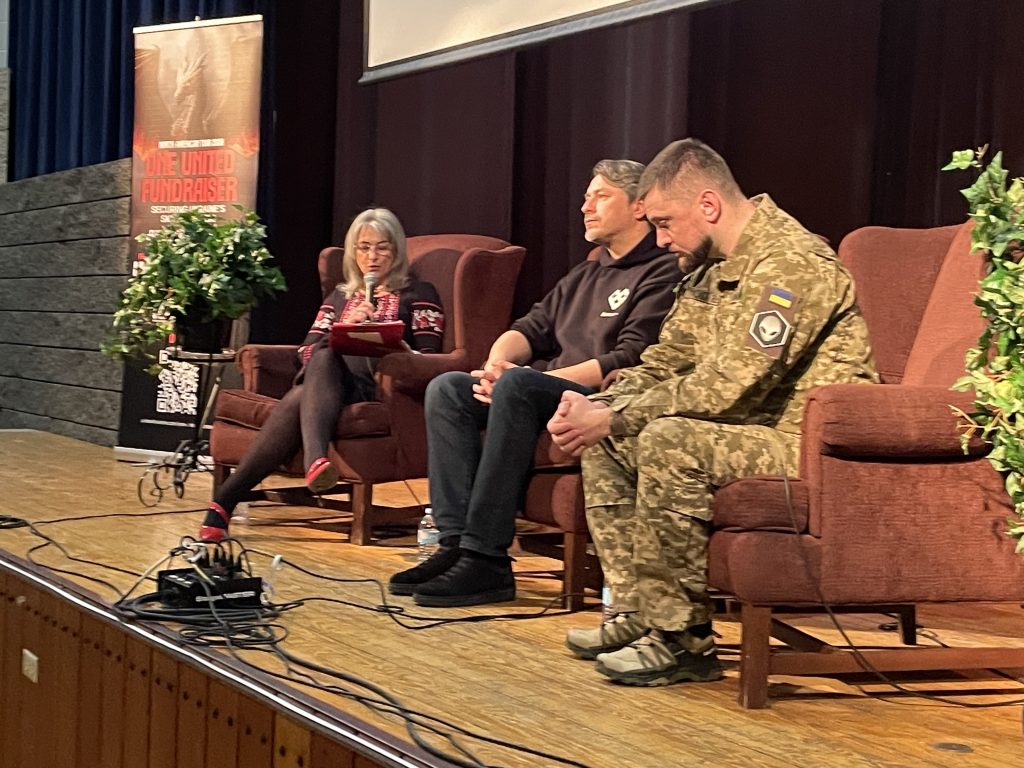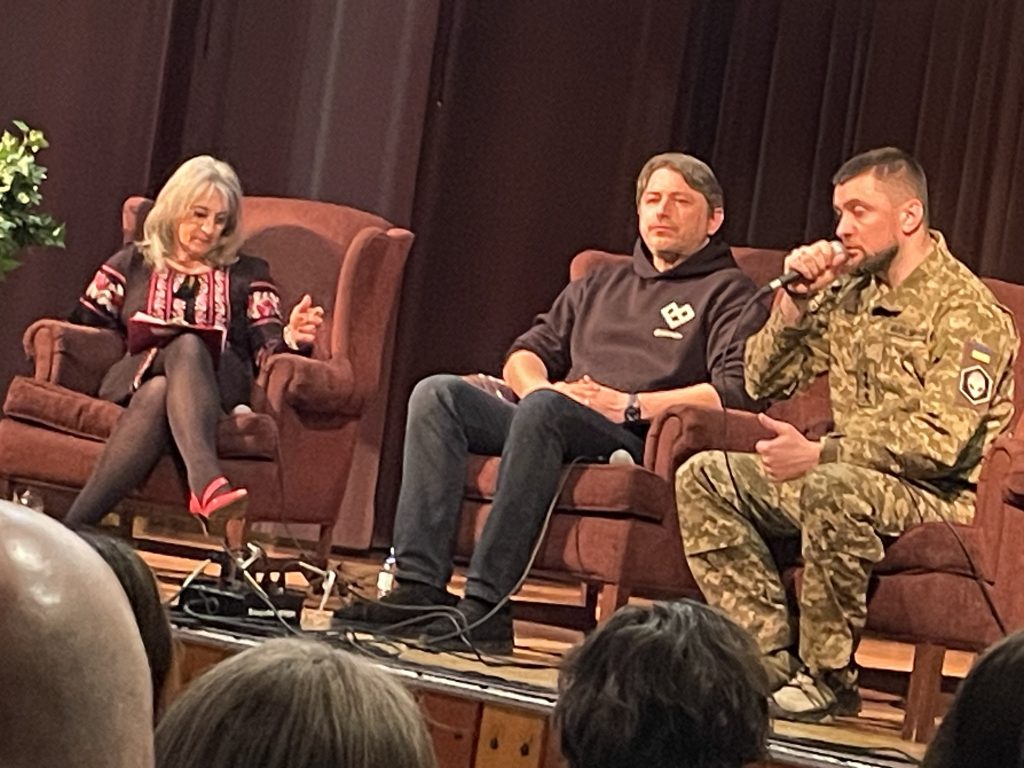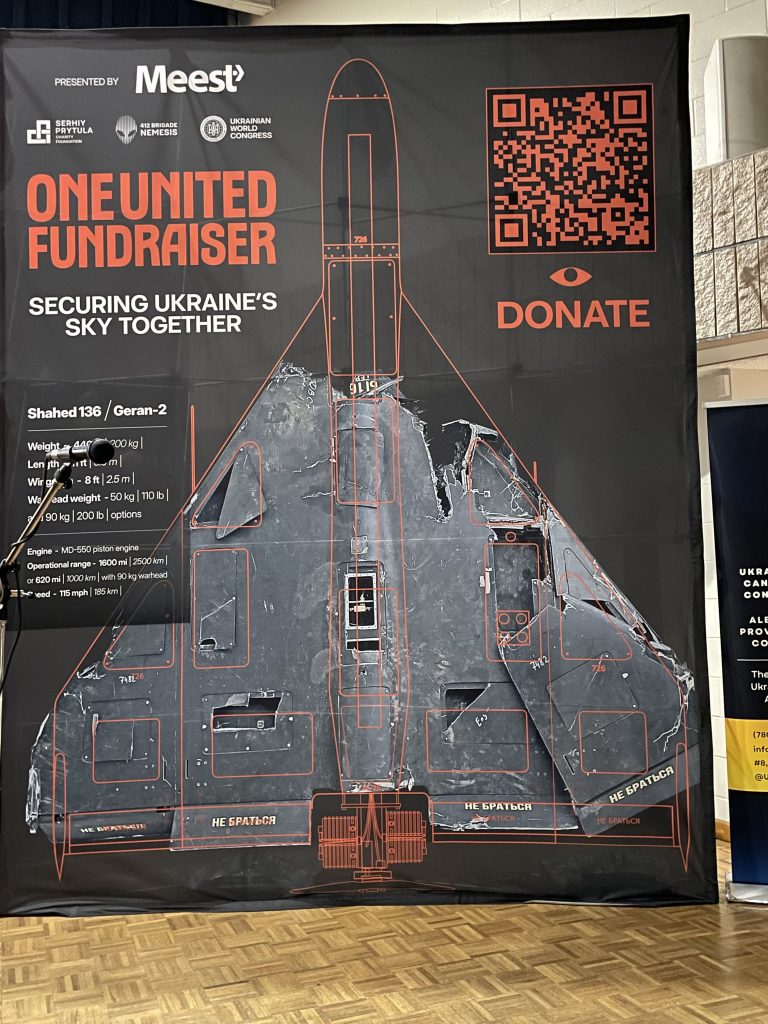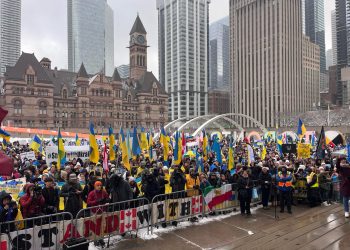




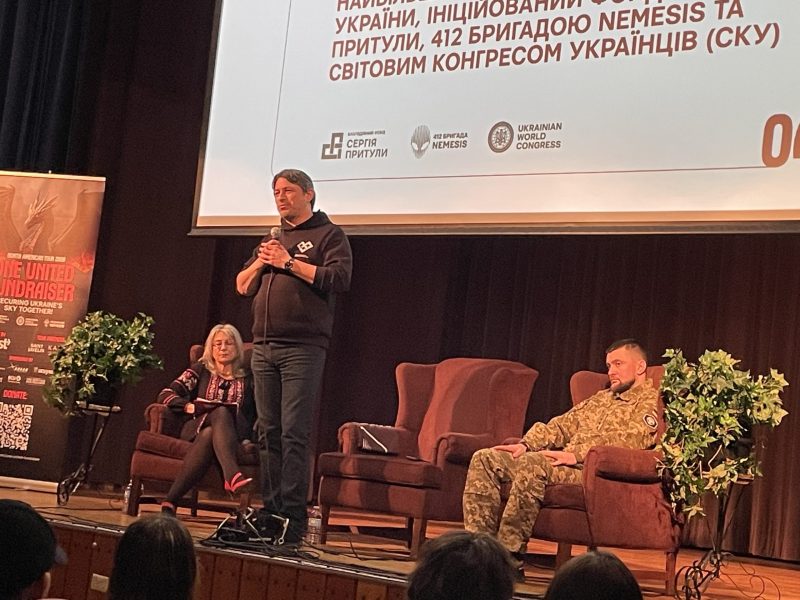
Edmonton, Alberta was the site of one of eight North American cities to host a community fundraising event titled One United Fundraiser (Єдинозбір)–2026 North American Tour, on January 28, 2026. This fundraising campaign was launched by the Serhiy Prytula Charity Foundation, the Ukrainian World Congress and the 412th Brigade “Nemesis” of the Unmanned Systems Forces of the Armed Forces of Ukraine. Several hundred people attended this event held at the Ukrainian Youth Unity Complex. This was Ukraine’s largest fundraising campaign with the very important goal of raising money to support frontline defenders and to protect civilians and critical infrastructure from mass Shahed drone attacks.
The goal of the One United Fundraiser campaign was to raise 1 billion Ukrainian hryvnia (UAH), or approximately $23–24 million USD, (based on current exchange rates), to finance smart drone interceptor systems and other critical equipment that save lives, protect cities, and help keep Ukraine’s energy and civilian infrastructure operational. Nearly 198 million UAH (approximately $4.5–4.7 million USD) was already raised in Ukraine. North American communities were called on to help reach this extremely crucial goal.
Olesia Luciw-Andryjowycz, National President of the League of Ukrainian Canadian Women opened the event and called for a moment of silence to honour those who have paid the ultimate price in the defence of Ukraine. She noted, that as with most fundraising events, support and sponsorships by community organizations and business is essential. The One United Fundraiser campaign received broad support from Ukrainian Canadian businesses and included: Presenting sponsor MEEST. Gold sponsors were Ukrainian Credit Union, Ltd., ICS Facility Services, The Heritage Foundation of First Security Federal Savings Bank. Silver sponsors included Rodan Energy Solutions, Blue Tactical LLC, BCU Financial Group, and local partners and organizers, included the Ukrainian World Congress, the Ukrainian Canadian Congress-Alberta Provincial Council, the Edmonton Branch of Ukrainian Canadian Congress, the Edmonton branches of the Ukrainian Youth Association “CYM,” the League of Ukrainian Canadians and the League of Ukrainian Canadian Women as well as the Ukrainian Youth Unity Complex.
Luciw-Andryjowycz also underlined the exceptional support by the Myhal Family Foundation and its founders George and Rayla Myhal, who will match dollar for dollar all donations gathered during this tour through Canada and the U.S. up to $500,000. Additionally, many volunteers gave generously of their time and helped in numerous ways. A special thank you went out to Taras Zakordonski who looked after the audio-video matters and to photographer Yaroslav Petriw for creating a photo record of the event. A short video presentation showing the work being done on the ground in Ukraine followed.
Two very special guests, speakers for the One United Fundraiser, were the highlights of the evening. Serhiy Prytula and Senior Lieutenant Oleksandr Yarmak of the Armed Forces of Ukraine (AFU).
Serhiy Prytula is a Ukrainian public and political figure who was a popular TV presenter and actor. After the russian invasion of Ukraine, he founded the Serhiy Prytula Charity Foundation that focuses on raising funds for the needs of the Armed Forces of Ukraine. This foundation has become one of the most influential volunteer initiatives in Ukraine. Since the early days of the war, Prytula, has led large scale fundraising efforts and coordinates aid for the AFU providing critically important equipment including drones, transportation, communication tools and the like.
The second speaker, Senior Lieutenant Oleksandr Yarmak is a well-known, successful Ukrainian musician who performs and creates in the pop and rap genre. As noted by The Independent on February 8, 2025, “He is also a chart-topping artist who has used his years fighting on the frontline, turning his experiences into rap songs that have become national war chants.” Oleksandr joined the Territorial Defense Forces that are part of the AFU in 2022 after the full-scale invasion of Ukraine. He progressed to command a frontline drone unit, currently serving as the commander of the Darknode battalion within the 412th “NEMESIS” Brigade. Yarmak and his colleagues work to develop and test new technologies. He heads research and development in Ukraine’s drone warfare inventing ever more ingenious was to use the new technologies in the most effective and cost-efficient manner possible. He is fully involved in defending Ukraine’s airspace and protecting civilian infrastructure and frontline units.
Serhiy Prytula showed an informative power point presentation that quantified and demonstrated the many tasks done on the ground in Ukraine by the Foundation. This overview documents the dynamic, wide-ranging and exemplary work of the Foundation and its countless volunteers.
The moderator for the evening, introduced by Luciw-Andryjowycz was Lydia Migus, President of the Ukrainian Canadian Congress-Alberta Provincial Council who started the conversation with questions for the guests.
Oleksandr, until 2022, you were a well-known Ukrainian musician and after February 2022, as a soldier, then commander of the 412th Brigade “Nemesis.” What made you leave the cultural front and take up arms?
“Learning Ukrainian history, all the periods of the Ukrainian Nation’s struggle for independence, made me realize that at every stage of that struggle, the russian empire, muscovy, constantly stole everything from us, constantly humiliated us, destroyed us and never recognized us as a nation. That is why it was obvious to me that there would be a full-scale invasion. I prepared for it. I understood that everything was leading up to this. Accordingly, as I sang about it, those who know my songs understand that my songs were based not only on promoting patriotism but also nationalism. Today hundreds of thousands of young Kozaky are defending our country. Unfortunately, many have died, many have become Heroes of Ukraine, and that corresponds to what I have always sung about. So it is a consistent path.”
Lt. Yarmak continued: “Today in Ukraine, it is not possible to be just a musician or just a successful TV host. Nowadays, you have to have and understand your place Ukraine’s defense system. Because when you are prepared, in any emergency situation, you clearly know where you need to go and what you need to do…When there was a threat to the loss of Ukraine’s independence and statehood, it was absolutely logical for me to join the military, set a personal example, and show my listeners and everyone else that I would do everything possible to protect my country. So, at some point, the military drew me in so much that I had to grow and become a commander…and now we are asked to grow again…but that is our fate. In a sense, we did not choose it, fate chose us…and we keep working.”
Our communities constantly hear about hundreds of different fundraisers and needs in Ukraine-from humanitarian aid to military support. How is this particular fundraiser different from others, and why is it worth supporting and investing in interceptor drones, especially now?
Prytula replied: “Because first of all, we cannot afford to shoot down a Shahed drone with a missile that costs a half a million dollars. In September [2025] twenty Shaheds flew into Poland who scrambled F-35s to shoot down Gerbers and Shahed drones with missiles that each cost $1.2 million euros. Sorry, but we cannot fight that way.”
“This is fundraising, this is an opportunity to provide thousands and thousands of inexpensive anti-Shahed drones of various types….it is effective, it is an economical solution to the problem. Plus, where there are funds available from some projects, we are more flexible than government, we are faster in decision making concerning procurement, in logistics…”
Prytula explained the Foundation builds connections with small local producers of drones, thereby supporting Ukrainian enterprises. Unlike governments that usually need to deal with large and well-known producers, the Foundation can afford to deal with small companies. Then if the government sees good results with the small enterprises, it might also sign production contracts with the small producers in the future. This is incredibly positive, it is a win-win-win situation for all parties.
Secondly, Prytula confirmed that the Foundation recognizes there are many volunteer initiatives here [ in Canada] and they do not want to interfere with anyone’s work, but he encouraged the audience, that when we choose what causes or projects to donate funds to, we should first consider where we are giving money and what we are giving it for. He encouraged everyone to support those who work on the ground in Ukraine because it is especially important to support local businesses and producers. He gave just as one example, that there are groups that send food parcels to Ukraine. There are food supplies available in Ukraine. Sending food products from abroad, weakens Ukrainian producers and entrepreneurs who can deliver food products. Prytula urged us to ask what the funds we are donating are going for and how they will be used so as not to waste valuable resources.
The speakers’ presentations inspired many of questions from the floor. One young lady, a recent arrival in Canada, asked what the younger generation can do to support the work of the Foundation. Both speakers responded that keeping the war in Ukraine in the news is particularly important. The diaspora can provide the messaging needed to keep the public and politicians informed about the war. Prytula also talked very passionately about how the recent diaspora can consider returning to Ukraine to share its new-found experiences, knowledge, skills and understanding to help with the reconstruction of Ukraine.
Other individuals were interested in the intricacies of purchasing and pricing for various drones and other supplies. Yarmak responded by offering some examples of types of interceptor drones and their varied costs. Prytula clarified how the procurement process works and how the Foundation endeavours to source the best equipment for the best price.
Another question inquired about the relationship between the Prytula Charity Foundation and the Government of Ukraine, specifically, the AFU; how is the work of the Foundation coordinated or integrated with government and the armed forces? Prytula explained that as a non-governmental organization, they lobby all levels of government and have constant contact with various ministries to ensure cooperation, coordination and the effective use of Foundation resources. He explained that they do not talk with ‘individuals’ but rather with the ‘positions’ to ensure the best outcomes can be achieved. He further explained in detail, now the Foundation tries to use the tax system to its benefit in that as a charitable NGO they can take certain steps that do not trigger taxes and customs duties as would be the case with some enterprises or private individuals. The Foundation aligns its work with the needs of the AFU. Prytula himself meets with many different ministers of state and recently met with President Zelenskyy to ensure that all parties work cooperatively for the greatest benefit to Ukraine. Prytula stated that thankfully the cooperation with the government is healthy.
An interesting question concerned the production of drones. As the ruzzians produce more drones, the more the Ukrainians have to produce to intercept them, creating the need to out manufacture each other. All these drones create debris over Ukraine and the country is damaged. Instead of buying interceptor drones would it possible to build a few large missiles in their place that could be directed at strategic points? Yarmak replied that the technology for missiles cannot be developed in a short time. The technical staff is needed to build them and then staff needs to be trained to use them, and this takes years. Ideally, the interceptor drones would also be temporary, and the missiles would be affordable, but we do not have them. Yarmak stated they must use the means that are available. He also noted that the Shahed drones have many imported components. The Ukrainian diaspora can lobby their governments to increase sanctions on the countries and manufacturers of components that are used in Shahed manufacturing. This would prevent the export of components used to build Shaheds and kill Ukrainians.
Another individual asked about the efficiency of the Foundation in acquiring the materials and equipment needed in Ukraine. Prytula provided, as an example, the purchase of a tomography machine for a hospital. He explained the Foundation gathered donations, reached out to the city government for a commitment of additional funds and then negotiated with manufacturers for the purchase of needed equipment. This negotiation concluded with purchasing the equipment for about one-half its original purchase price. The Foundation’s goal is to use its financial resources very judiciously and avoid waste.
Given that Prytula encouraged young people to return to Ukraine after the war to help rebuild the country, another young woman questioned what it might be like for young people returning to Ukraine with new skills and experiences? Yarmak replied that when a young person returns and genuinely wants to contribute to the reconstruction of Ukraine they are evaluated for their sincerity and willingness to work for the betterment of Ukraine. Yarmak feels it boils down to respect and conscientiousness of the person and their willingness to contribute to the rebuilding. He encouraged all young people to stay connected to Ukraine and its people and the needs of their homeland. He feels that Ukraine absolutely needs these young people and welcomes them to Ukraine.
Prytula also responded by relating that in his experience, Ukrainians living abroad would like to return but are hesitant because they fear how they will be treated after having lived abroad in safety while their Ukrainian counterparts were living under war conditions? Prytula stated this will be a challenge and there is a segment of Ukrainian society that indeed feel negatively toward those returning. However, he hopes there will be sufficient resources and willingness on the part of government to develop social programs that will work to mitigate tension between Ukrainians who were in Ukraine and those who were abroad during the war.
Prytula was emphatic that Ukrainians, regardless of these circumstances, must return after the war because the economy and society will need rebuilding. Their new skills, experience and knowledge are very important. If returning Ukrainians are not part of this process, then the economy will be rebuilt by foreign investors and migrants from other countries. After the war Ukrainians will need to embrace each other and work together to rebuild their country. “Every Ukrainian willing to work will be worth his weight in gold,” said Prytula. He hopes that Ukrainians will look forward to the future in the context of what life was like before the war.
Yet another young woman asked about opportunities to work with the Foundation while in Canada and whether remote cooperation would be possible? Prytula responded very positively encouraged her to connect with the Foundation to see where she might be able to assist.
Limited by time, the Q & A’s concluded. Prytula explained that as a private individual, unlike Lt. Yarmak, he can speak freely and very directly asked those present to contribute as generously as possible to support the Foundation’s work. He reiterated the extreme importance protecting Ukraine’s population and the strength of the Armed Forces of Ukraine.
The event concluded with Shche Ne Vmerla Ukraina and closing remarks were given by Lydia Migus. An opportunity to meet the speakers and take pictures followed.
Slava Ukraini! Heroyam Slava!
Lidia M. Wasylyn