




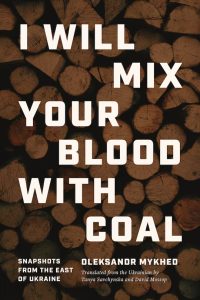
 I Will Mix Your Blood with Coal: Snapshots from the East of Ukraine by Oleksandr Mykhed is a literary exploration of Eastern Ukraine, particularly the Donetsk and Luhansk regions, blending travel narrative, history, interviews, and cultural commentary. It engages deeply with the lived experience of people in the region long before Russia’s full-scale invasion and during the ongoing war.
Mykhed, a PEN Club member, visits cities such as Severodonetsk, Bakhmut (a city that has largely ceased to exist), Lysychansk, and Dobropillia. He explores the unique identities and characteristics of these places, going beyond the common perception that the region exists solely around industry. The author shows that the coal and other resources extracted from the land have always been valued more highly than human life under every regime, a harsh reality that has left a lasting imprint on the people’s mentality, their experiences, and their hopes for the future.
The book is not conventional reportage. Instead, it blends travel narrative, historical storytelling, and reflections from Ukrainian intellectuals, combining first-hand conversations with locals, archival fragments, and insights from prominent cultural figures such as Serhiy Zhadan, Roman Minin, Olena Stiazhkina, Volodymyr Rafayenko, and Ihor Kozlovsky. Reviewers note that its strength lies in a polyphonic approach—presenting the voices of residents, miners, activists, and thinkers rather than a single authoritative perspective. This method reflects the real tensions and ambiguities of the region’s history and identity.
Mykhed’s portrayal traces industrial heritage, wartime traumas, and how landscapes like Severodonetsk or Bakhmut carry layered meanings. The stories of coal miners and everyday life surface broader truths about humanity, resilience, loss, and hope. His book provides insights into the foundations of Eastern Ukrainian identity, showing that it cannot be reduced to simplistic stereotypes. The author also raises broader questions about industrial legacies, social justice, and the struggle to build new identities in regions long shaped by extractive economies.
As Volodymyr Rafayenko reflects in the book, the lived realities of Eastern Ukraine go far beyond superficial labels or geopolitical narratives:
“What is the ‘Donbas identity’? We should probably start with a clarification that Donbas is the Donbas coal basin, which mostly doesn’t coincide with the occupied territories, nor with Ukrainian territories as such… In our case, it was the other way around. Having already built industrial facilities, the state used the money left over to build a theater or circus with a dolphinarium… The total subordination of the human community to artificial and mechanical formations of civilization produced unnatural rhythms of human existence… Coal and metal eventually became symbols that were considered superior to any other values… A person from this world doesn’t trust conversations about culture and politics. That person would rather stick to ‘simple work guidelines’ and understandable values… It’s easy to deceive those who are not used to verifying the objective world with invisible laws and certain principles of creating meaning for the sake of understanding reality” (Mykhed 296–297).
This passage captures the essence of Mykhed’s approach: Eastern Ukraine is a region shaped by industry, history, and layered cultural dynamics, where human life and creativity have often been subordinated to mechanized and ideological structures. The book does not attempt to provide definitive answers or exhaustive sociological analysis; instead, it offers clues and reflections that allow readers to engage with the emotional and cultural textures of the region.
Ultimately, I Will Mix Your Blood with Coal is both a vivid chronicle of life dependent on coal and a poignant reflection on dignity, identity, and resilience in a region scarred by history, exploitation, and war. It challenges readers to reconsider preconceptions about Eastern Ukraine and invites reflection on the human costs of industrial legacies, conflict, and social transformation.
Works Cited
Mykhed, Oleksandr. I Will Mix Your Blood with Coal: Snapshots from the East of Ukraine. Translated by Tanya Savchynska and David Mossop, Northwestern University Press, 2025, pp. 296–297.
…
We met in December 2019 in Kyiv and talked about compassion, elusive jazz, and the state’s responsibility for ensuring that people can preserve their humanity.
What is the “Donbas identity”? We should probably start with a clarification that Donbas is the Donbas coal basin, which mostly doesn’t coincide with the occupied territories, nor with Ukrainian territories as such. So when we talk about eastern Ukraine and use the term “Donbas,” we are actually doing what both the tsarist and the Soviet authorities did: We are evaluating the world of culture through the lens of industry and money. So we made a mistake at the very beginning of the conversation.
However, in the general media sense, this is already the established name of the region, there’s no denying it. When people say “Donbas,” they don’t usually mean the area of coal deposits. A few things need to be clarified before the conversation about identity. First, Donbas, in the cultural sense, is Ukraine. Second, in the twentieth century, these Ukrainian lands were firmly united not just by industry, but also by their postwar fate — I mean the Second World War. This fate was as follows: The villages remained more or less Ukrainian, and the cities were quite quickly Russified. These are well-known facts.
There was no one left to rebuild Donbas after the war. So specialists and ordinary working people from Russia and other Soviet republics began to arrive here en masse. Obviously the only possible language of the urban conglomerates was Russian. These processes clearly influenced the formation of the region’s culture, in particular of its national map.
Concerning my city (first it was luzivka, then Stalino, and then Donetsk, at the end of the nineteenth century it emerged as an urban mechanism in a rather unnatural way for Ukraine. I mean, in a normal situation, culture appears first, and then industry. In our case, it was the other way around. Having already built industrial facilities, the state used the money left over to build a theater or circus with a dolphinarium.
What was becoming increasingly important was not the values of human life, but the factory where a person worked. People woke up to the sound of a whistle, and they went to bed to the sound of a whistle. They lived between morning and evening whistle, and not between Easter and Christmas.
The total subordination of the human community to artificial and mechanical formations of civilization produced unnatural rhythms of human existence. This in turn determined a specific mentality, a special attitude to life. Coal and metal eventually became symbols that were considered superior to any other values.
To those mental tendencies that already existed, the Soviet authorities added denationalization, and the internalization of cities, first of all Donetsk. Obviously, the state didn’t want any problems with the national identity of the workers — Ukrainian, Russian or any other. And instead, it needed a factory as a mechanism that wouldn’t cause any problems. That’s why such ideological standards, a kind of etiquette of an industrial region, were created, where the issue of national identity became absolutely marginal and excluded from the generally accepted social discourse. Conversation about cultural vales was allowed only within permitted limits, that is, as an official pathos that has nothing to do with real lite.
This is how a special style was created, a way of thinking where a mechanism, a machine, a tool deserved trust, but that was not the case for a book, a piece of music, and definitely not a history text-book. A person from this world doesn’t trust conversations about culture and politics. That person would rather stick to “simple work guidelines” and understandable values. But one thing is clear: When there’s a lack of cultural foundation, no matter how wise a person considers themselves and no matter how substantive their knowledge and skills, they will become, in the intellectual sense, endlessly vulnerable, gullible, paradoxically combining practical adequacy and impressive naivete. As a rule, a specificity, even a certain rigidity, of thinking is combined in such a personality with the lack of immunity to the world of ideological structures. It’s easy to deceive those who are not used to verifying the objective world with invisible laws and certain principles of creating meaning for the sake of understanding reality.
…
Nadia Lemko