


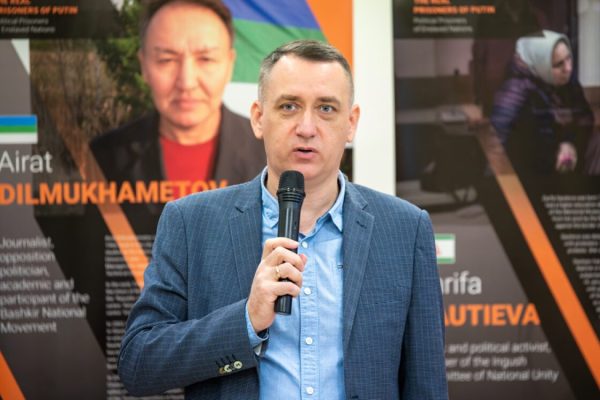
Mr Oleh, do you see support from the authorities and politicians in Ukraine for the activities carried out by the Anti-Imperial Block of Nations? What support is there from ordinary Ukrainians for your work?
The Anti-Imperial Block of Nations, both in Ukraine and abroad, systematically works with politicians, human rights activists, and authority representatives to support the national liberation movements of the enslaved nations.
What we have achieved is that a Temporary Special Commission has been established in the Verkhovna Rada of Ukraine on this issue. The National Deputies of Ukraine, together with experts, have developed a separate draft law, at the state level, on Ukraine’s support for the enslaved nations.
I hope that the Ukrainian authorities will have enough political will to adopt this bill and implement its main provisions.
Also, we constantly communicate with others abroad on the topic of protecting the rights of the indigenous nations of the Russian Federation.
For example, our human rights project was presented in the Canadian Parliament, the Italian Senate, and the Spanish Congress of Deputies. The Committee of the Anti-Imperial Block of Nations in the USA constantly transfers our appeals to the American authorities. We must admit that the issues we address to American or European politicians are mostly unfamiliar and incomprehensible to them. Therefore, we have to make much more effort to convey our ideas and proposals.
As for ordinary Ukrainians, we are also forced to carry out some informative, educational work on the topic of the decolonisation of Russia. For many Ukrainians, this topic is also complex and incomprehensible. Therefore, we organise various events, during which we emphasise that the fate of, say, the Chechen, Circassian, Bashkir or Kalmyk peoples is very similar to the fate of our people: involuntary accession, repression, Holodomor and ethnocide by Moscow are common markers of our history. The Anti-Imperial Block of Nations, advocating for the right of nations to self-determination and the struggle for freedom, fights for the final collapse of the Moscow empire, which is the greatest threat not only to Ukraine but also to the entire civilized world. We understand that Ukraine’s final victory in the war will be not only the restoration of its territorial integrity, but also the creation of several dozen new independent states of enslaved nations on the territory of the modern Russian Federation.
Do you consider the indigenous nations as a separate part of Russia, as someone who is not responsible for the ongoing war?
Today, both the Kremlin authorities and the citizens of the Russian Federation who silently support this aggression, regardless of their nationality, are equally responsible for Moscow’s aggression.
However, the national liberation movements of the enslaved nations have openly condemned Russia’s attack on Ukraine. They are on our side, they are our allies. Moreover, a small but worthy part of them is now fighting side by side with Ukrainian soldiers. These are Chechens, Ingush, Karelians, Yakuts, Kalmyks and others. There are not as many of them as we would like, but today, in combat conditions, they are already forming the core of their national liberation armies. Therefore, we are oriented towards them and will cooperate with them.
Do you think it is realistic that some regions of Russia will be able to gain independence?
Yes, of course, this is an absolutely realistic scenario. First of all, these are the nations that declared sovereignty or independence after the collapse of the Bolshevik Empire. The Chechen Republic of Ichkeria, which waged two blood-spilled wars against the Kremlin and its leaders, other countries of the North Caucasus: Ingushetia, Dagestan, and Circassia. These are the countries of the Volga region or the Idel-Urals: Tatarstan, Bashkortostan, Chuvashia, and Udmurtia. The same Buryatia, Yakutia or Tyva. In all of the listed and other republics of the so-called Russian Federation today, there is the potential to create their own independent states in the near future.
As part of the training of students at the University of Free Nations, we are engaged in preparing the future management elites of these states, educating future deputies, government officials, and even Presidents.
How, in your opinion, does the war affect the indigenous population of Russia? Do they become targets more often than Russians?
The war has an extremely negative impact on enslaved peoples. The Moscow authorities use them as “cannon fodder” in the war. Our monitoring and analysis give us the right to assert that the Kremlin is not only fighting with the hands of enslaved peoples but is also committing actual ethnocide, destroying their men in the crucible of war. There are some small nations that, due to war, may simply disappear. After all, this has always been the case in the history of empires, especially Moscow’s. Putin and his entourage have not invented anything new.
Do you think that Russia is actively trying to destroy ethnic minorities, to assimilate them?
A vivid example of this is the proclamation of the so-called year of “unity” of the nations of Russia.
In fact, this is an attempt to finally assimilate more than a hundred nations under one heading — “Russian”. Again, nothing new under the imperial sun: this was the case, for example, during the USSR, when the Moscow centre tried to create a “Soviet man”, a “sovka”. But they failed. And they will not succeed at this stage.
After all, it is very difficult to force representatives of different cultures, religions and traditions into one template. Those who remember the liberation struggle of their ancestors. Those for whom the example of Ukraine gives hope and a chance for national liberation!
What does the ABN think about potential cooperation with ethnic Russians, opposition politicians who want to preserve the Russian Federation? For example, such as Navalny or Kasparov.
We consider most of these politicians to be just as imperialist as Putin. Therefore, we do not foresee any cooperation at this stage or in the future.
We always emphasise this at meetings with our Western partners: do not have any illusions that someone from the so-called “Russian democratic opposition” will be better than Putin, but rather support the national liberation movements of enslaved nations, recognise their right to fight for freedom, and start building good neighbourly relations for the future right now.
From your experience: as politicians, how do people in the West react to your work? Is there any support or sympathy? Is it growing?
We feel strong support in all civilized countries where we have visited with our projects, or where the ABN is represented. Of course, many politicians or ordinary people in the West are frightened by expressions like “the collapse of Russia” or “the collapse of the empire”, so we offer them more understandable formulations – the decolonisation of Russia, the protection of the rights and freedoms of enslaved nations.
We believe that our activities, as well as the work of all national liberation movements and associations of enslaved nations, will bring qualitative results and support for our struggle will grow. After all, this struggle is important not only for us, but also for the entire civilized world.
What do you think other countries should do to really help the indigenous nations of Russia? What is Ukraine doing now in this regard? What should it improve?
There is actually a lot of work to do. It is very important for us that the activities we are currently doing in the anti-imperial sphere at the public level, in the near future, in Ukraine, become part of state policy. Western countries should take an example from Ukraine, which is a kind of “Ramstein” for enslaved nations and provide them with comprehensive assistance.
We have the recent example of Lithuania, where a parliamentary commission has been created in the Seimas to deal with the issue of supporting enslaved nations. We have the Captive Nations Week, which has been held in the USA for over half a century.
I think this is just the beginning of a long journey that will lead to the victory of the ideas of freedom.
I hope that it will not take too much time and that in the near future new independent states will appear on the world map.
If Russia and Ukraine sign a peace treaty, how will this affect the work of the ABN?
I do not believe in the effectiveness and truthfulness of any treaties with Russia, but I believe in the sacred right to fight for freedom. But if some document is signed, it will not affect our activities at all, because the desire for independence cannot be limited by any document.
Will the ABN continue its advocacy activities after the conclusion of a potential peace agreement?
Yes, of course. Perhaps we will even be able to intensify our work, because those activists who are now defending Ukraine, with weapons in their hands, will return to our ranks. Our goal is clear and unchanging — moskovia delenda est!
An interview with Daniel Y.