



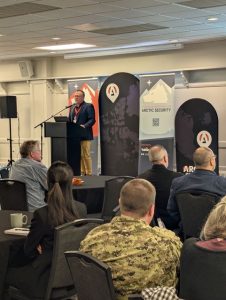
Last week, from February 23 to 25, the Whitehorse Chamber of Commerce in Yukon hosted officials and investors from across Canada’s North for this year’s Arctic Summit.
The event, held with the support of the Canadian Institute for Arctic Security, brought together approximately 500 industry experts, government decision-makers, and Indigenous leaders to discuss issues related to sovereignty, security, infrastructure, resource development, and other critical regional priorities shaping the future of the Arctic. The summit focused on moving beyond rhetoric toward measurable action aimed at building a resilient North.
Among the topics discussed was the growing concern over foreign influence and disinformation, particularly from Russia and China, and the potential impact such activities may have on local communities.
One of the experts on the issue, who presented during the event, was Marcus Kolga, a Canadian journalist, human rights activist and one of Canada’s leading analysts of foreign propaganda and influence operations.
In a recent interview with Homin Ukrainy, Kolga noted that while the main goal of disinformation is often designed to polarize society, in the Canadian North, the primary objective for the Russians appears to be the control of natural resources. According to Kolga, Russian actors frequently employ one of their most common propaganda strategies – deflection. They accuse Canada of immoral or illegal actions while engaging in that very conduct themselves.
One of the key narratives promoted through such disinformation concerns in the Canadian North is the militarization of the Arctic. Kolga noted that over the past twenty years, Russia has aggressively expanded its military infrastructure in the region while simultaneously advancing claims over vast Arctic resources beneath the seabed, extending right up to Canada’s 200-mile exclusive economic zone. He also pointed out that Russia’s official documents all state and instruct institutions to engage in resource expansion, essentially promoting resource-driven imperial ambitions in the region. At the same time, Canada’s lawful military policy in the Arctic continuously face persistent criticism, disinformation campaigns, and Russian backlash.
“Whenever we announce that we are going to build any infrastructure in the Arctic, if we are engaging in military exercises with our allies, such as Sweden, Finland and others, Russia immediately reacts to claim that we are actually trying to provoke a conflict with them there, which often leads us to back off, because we want peaceful coexistence. That creates reflexive control, which is one of the main angles of Russian disinformation in the region’’, says Kolga.
In some cases, propaganda can extend so far as to influence legislation. That’s how the 2009 European ban on the import of seal pelts and other seal products from Canada was established. Russian disinformation campaigns played a significant role in shaping public perception, targeting Canadian seal hunters through false accusations of illegal activity and the circulation of images and narratives taken out of context. “No one likes to see images of seals being clumped, for example. Although in truth, there are strict regulations in Canada that prevent professional hunters from doing that. That’s not how they engage in the hunt. But pictures that have been taken out of context are often used to try to malign the craft’’, the expert highlights.
In order to further spread their disinformation and false narratives about Northern communities and influence Canadian public opinion on them, Russians actively use social media platforms and famous online personas.
“Russia is most effective and most impactful through the use of influencers. So these are Canadians and Americans who have a very well-known online media presence, whether it’s through blogs or podcasts, or even some known journalists, through whom they are able to take their propagandistic narratives from the state media level and inject them into this influencer network. They then launder the state’s fingerprints off those narratives, lending them credibility and spreading t hem almost organically amongst Canadian and US social media networks’’, says Kolga.
Taking that into consideration, the expert says the public should filter their news consumption and be mindful of their news sources.
“I would say limit your exposure to social media. Get a newspaper subscription. Trust journalists, especially mainstream ones. They are trained to handle facts. What you shouldn’t be trusting is a podcaster who is maybe motivated just by making a quick buck with some advertising on his YouTube video blog or otherwise. And be aware of any sensationalist claims that those sorts of bloggers make or any sort of sensational claims that you might see on Twitter, Facebook, or any other social media feed. That’s how we can personally start protecting ourselves’’, says Kolga.
When it comes to countering state-level propaganda, Kolga emphasizes that consistent and transparent communication between the Canadian government and Northern communities is essential.
“Since the Northern communities are the ones that are being targeted by disinformation, they’ll know how it’s happening. So we should be asking them and talking to them about what they’re seeing and then focus our analysis on that and make sure we can develop countermeasures, like counter-narratives. It could be pre-bunking, which is a sort of preemptive inoculation against propaganda. We can then determine how best to proceed in doing that, but it requires everyone working together’’, notes the expert.
This information warfare will continue into the future, making it imperative for Canadians to remain vigilant and united to safeguard national security and preserve societal cohesion.
Oleksandra Chorna