



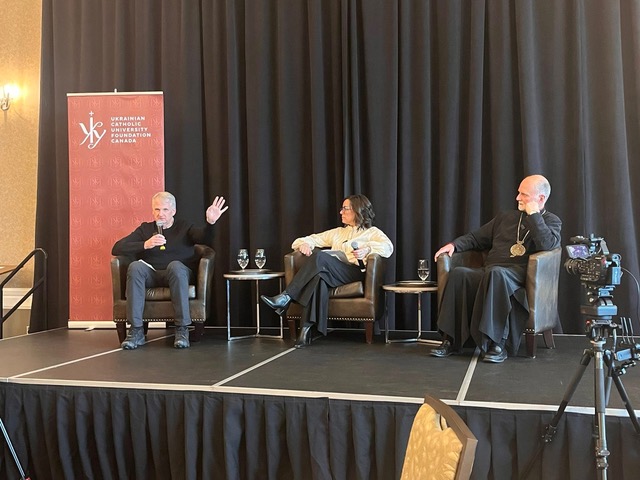
On Sunday, March 22, 2026, the Ukrainian community gathered at St. Joseph Ukrainian Catholic Church for a Gala Fundraising Luncheon in support of the Ukrainian Catholic University (UCU) in Lviv. Organized by the Toronto Friends of UCU and chaired by Olia Kalymon, the event brought together spiritual and community leaders, sponsors, supporters, and friends of UCU for an afternoon marked by reflection, purpose, and hope.
Opening remarks were delivered by Andriy Ilnyckyj, Acting Chair of the UCU Foundation in Canada, who welcomed guests and introduced Larisa Galadza, a member of the UCU Senate and former Ambassador of Canada to Ukraine. Serving as master of ceremonies, Galadza guided the program and moderated a thoughtful discussion that bridged education, history, diplomacy, and lived spiritual experience.
The event featured two distinguished speakers, Metropolitan-Archbishop Borys Gudziak, President of UCU, and Professor Timothy Snyder, Temerty Chair in Modern European History at the Munk School of Global Affairs and Public Policy at the University of Toronto. Together, their reflections offered both moral clarity and intellectual depth, illuminating the role of education in times of profound uncertainty.
In a message that resonated deeply with those in attendance, Metropolitan-Archbishop Gudziak spoke of the ongoing war in Ukraine not only as a geopolitical struggle, but as a test of truth itself. Referencing the biblical question “What is truth?”, he underscored the stark moral realities Ukrainians face daily. “In this hybrid war, everyone has their foxhole, blockpost, or checkpoint,” he wrote. “The Ukrainian Catholic University stands on the educational frontlines.” At a time when destruction threatens institutions and lives alike, UCU continues to form leaders grounded in dignity, responsibility, and service. Education, as Gudziak emphasized, cannot be postponed, and it must remain practical, innovative, and rooted in enduring values.
Even amid war, UCU is actively shaping Ukraine’s future through concrete initiatives. The university has launched a bachelor’s program in robotics, equipping students with skills in engineering and artificial intelligence essential for reconstruction and national resilience. Its Medical Clinic serves both civilians and military personnel, including wounded veterans, while the Veteran+ Program provided free treatment to 250 veterans and their families in 2025 alone. At the same time, UCU’s Legal Clinic delivered more than 400 consultations to soldiers, internally displaced persons, and war-affected individuals, entirely free of charge and led by law students. These initiatives reflect a broader commitment that no one should be left alone in their suffering. The university strives to be a place where individuals are not only educated, but also supported, healed, and empowered. Among the many stories of resilience is that of Illya Pylypenko, a UCU student and war veteran, who was awarded the Order for Service by President Volodymyr Zelenskyy in early 2026. A two-time Invictus Games bronze medalist, Pylypenko embodies the spirit of perseverance and renewal that defines the UCU community.
Professor Timothy Snyder offered a broader historical perspective, inviting the audience to reconsider Ukraine not as a peripheral space, but as a longstanding centre of human civilization. Drawing on archaeological and cultural evidence, he illustrated how the lands of Ukraine have, for millennia, been a meeting place of peoples, ideas, and forms of social organization. He referenced archaeological findings in central Ukraine, particularly in the Uman region, where clusters of ancient settlements predate those of Mesopotamia. Unlike the monumental stone structures and hierarchical temple systems associated with Babylonian cities, these early Ukrainian settlements were organized in circular forms around communal gathering spaces, proto-maidans, suggesting a social order rooted in community rather than domination. Snyder further pointed to classical Greek art, noting that depictions of women warriors, often mythologized as Amazons, were not merely imaginative constructs, but reflections of historical encounters. Approximately one-fifth (20 percent) of the Scythian warriors confronting Greek societies were women, a reality confirmed through modern archaeological analysis. These figures, far from myth, reveal a longstanding tradition of female agency and participation in public and military life, a theme that continues to resonate in contemporary Ukraine.
Turning to late antiquity, Snyder highlighted the example of the Goths, peoples originating from the territories of present-day Ukraine, who, upon sacking Rome, refrained from destroying temples. As recorded by Augustine of Hippo, this act of restraint stood in contrast to Roman practices and underscored alternative cultural values emerging from the region. Such historical moments, Snyder suggested, challenge conventional narratives and point to a deeper, often overlooked influence of Ukraine on the development of European civilization.
In connecting these insights to the mission of the Ukrainian Catholic University, Snyder emphasized the critical role of intellectual institutions in preserving and rearticulating historical knowledge, especially in times when such knowledge is endangered. He reflected on how the destruction of institutions has often led to the loss of cultural memory, while communities of scholars persist in rebuilding, teaching, and seeking truth. Today, this work continues through global academic collaboration. Snyder is involved in an international initiative bringing together more than 100 scholars from 15 countries to produce a comprehensive, multi-perspective history of Ukraine. Notably, this effort is supported by a new generation of Ukrainian scholars and administrators, including Ruslan Labatsiuk and Uliana Kirchyk, whose work exemplifies the ethos of UCU: intellectually rigorous, values-driven, and community-oriented. As Snyder observed, such individuals not only advance academic projects, but also foster the connections and shared understanding necessary to ensure that Ukraine’s history is remembered, studied, and fully integrated into the global narrative.
Archbishop Borys Gudziak reflected on his many visits to Ukraine, 55 since the beginning of the war, including 15 after the full-scale invasion, sharing a profound observation that even amid the brutality of war, something transformative occurs when learning takes place in an environment rooted in love. At the Ukrainian Catholic University, education is not understood as the mere transmission of knowledge, but as a deeply human encounter. Students are not treated as passive recipients of information; rather, they are seen in the fullness of their identity, including their culture, their families, their experiences, and their inner lives. This philosophy has taken on even greater meaning in wartime. Despite loss, uncertainty, and sacrifice, the university continues to cultivate an atmosphere of trust, service, and solidarity. It is a place where intellectual growth is inseparable from compassion, and where learning becomes an act of resilience.
Gudziak emphasized that hope itself is relational. It does not emerge in isolation, but is born in community, just as knowledge deepens through dialogue and exchange. In this sense, Ukraine today stands as a powerful testament to human connection, a place where people come together, share ideas, and sustain one another through the most difficult of circumstances. Looking to the future, he expressed a quiet but profound hope that generations to come, including the students of today’s leading scholars, will recognize Ukraine as a place where the experience of learning is inseparable from the experience of love.
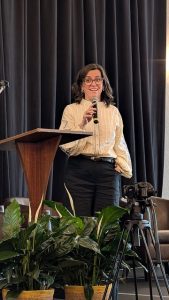
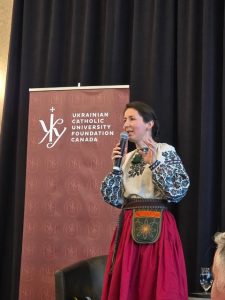
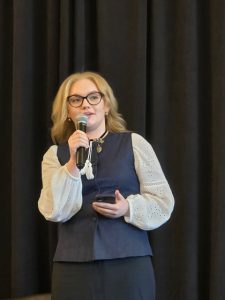
Among the speakers, there were also two graduates of UCU who spoke at the event. Dr. Marichka Ivaniv Lonchyna, who earned her PhD at the Faculty of Theology at the University of St. Michael’s College, University of Toronto, emphasized that her academic journey was made possible in large part through the support of the Ukrainian Catholic University and its dedicated donors. Reflecting on the meaning of philanthropy, she noted that giving is not only about the act itself, but about witnessing its impact, often not directly, but through the opportunities it creates for others. A similar message was echoed by Anastasiya Zvir, a UCU undergraduate and recipient of a scholarship from the Ihnatowycz Family Foundation, which helped support a year of her studies. These examples underscore the tangible impact of generosity, as demonstrated by donors such as the Ihnatowycz Family Foundation, Ms. Jarka Jaciw, and the Honourable Lida M. Barchynska Olah, a retired judge, whose contributions have supported key initiatives, including the development of the UCU Faculty of Law.
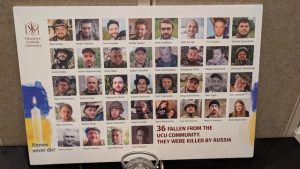
Founded in 2002, the Ukrainian Catholic University continues the legacy of the Lviv Theological Academy, established in 1928 by Metropolitan Andrey Sheptytsky. Today, it stands as one of the most dynamic educational institutions in Ukraine, with approximately 2,600 students, 800 staff members, and 600 graduates annually. Yet UCU is more than its numbers. It is a living community shaped by relationships, shared purpose, and a deep commitment to human dignity. Its guiding message, “You are the light of the world,” is not simply a motto, but a lived reality. That reality has come at a cost. Thirty-seven members of the UCU community have lost their lives defending Ukraine. Their sacrifice is both mourned and honoured, strengthening the resolve of those who continue their work.
The Gala Fundraising Luncheon in Oakville was not only a moment of reflection, but also a call to action. Funds raised will directly support scholarships, faculty, research, and the continued development of programs that respond to UCU’s urgent needs. “Your generosity creates opportunities,” Metropolitan-Archbishop Gudziak affirmed. “You give young people in Ukraine a chance to study, to serve honestly, competently, and responsibly.”
In a time marked by uncertainty and loss, the gathering offered something enduring, a sense of unity and purpose. It affirmed that education rooted in truth, sustained by community, and inspired by hope remains one of the most powerful forces for renewal. As Ukraine continues to endure and rebuild, institutions like the Ukrainian Catholic University stand as beacons of what is possible when knowledge, faith, and human solidarity come together.
Nadia Gereliouk