




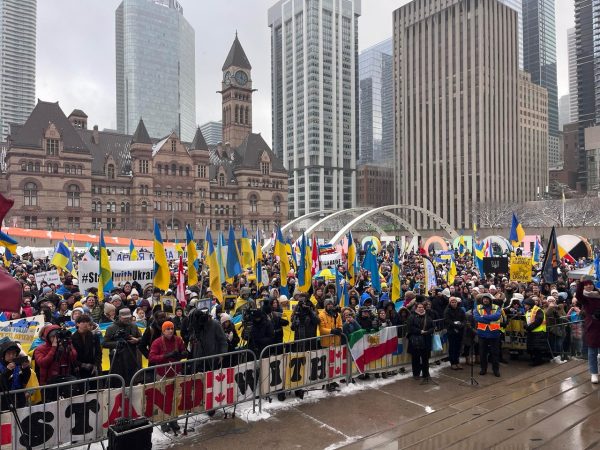
On Sunday, February 21, 2026, more than 60 coordinated events were held across Canada, from coast to coast, to mark four years since Russia’s full-scale invasion of Ukraine. Tens of thousands of people gathered in major cities, uniting Ukrainian communities, civic leaders, youth organizations, and allies in a powerful national demonstration of remembrance, solidarity, and resolve.
Vancouver
In Vancouver, thousands gathered at the Vancouver Art Gallery, before marching through downtown to Jack Poole Plaza and back. Organizers described the rally as “a public act of remembrance, solidarity, and resolve, a reminder that global support is not symbolic, but essential.” The march underscored the city’s sustained commitment to standing with Ukraine through both public action and advocacy.
Calgary
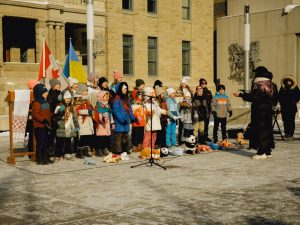
At Calgary’s Municipal Plaza, the rally took on a deeply human dimension. Children participated by singing and bringing stuffed toys, drawing attention to the humanitarian crisis facing Ukrainian children as a direct result of the war, displacement, trauma, and the loss of safety and stability.
Winnipeg
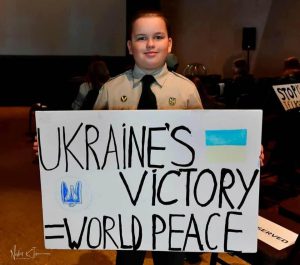
In Winnipeg, the Ukrainian community and allies gathered at the Canadian Museum of Human Rights. Youth participation was prominent, including members of the Ukrainian Youth Association, symbolizing generational continuity in advocacy and remembrance.
Premier Wab Kinew affirmed the province’s commitment: “On behalf of the Province of Manitoba – we will always support Ukraine. A free, independent, democratic Ukraine.”
Mayor of Winnipeg, Scott Gillingham added: “Today’s rally is an important expression of solidarity. It’s a reminder that we in Winnipeg, throughout Manitoba, throughout Canada have not forgotten. And that we will not look away.” Some attendees, including Amanda Anderson, emphasized that the gathering was also a moment to remember Canadians who lost their lives while volunteering overseas in support of Ukraine.
Toronto
Thousands assembled at Nathan Phillips Square in Toronto, where a reconstructed Shahed drone was displayed on stage, offering a stark visual reminder of the weapons striking Ukrainian cities daily. The rally drew significant public participation and the presence of numerous dignitaries.
Petro Schturyn, President of UCC Toronto, thanked attendees for their solidarity and urged continued advocacy within neighbourhoods, communities, and across broader society.
Ontario Premier Doug Ford called for unity, noting Ontario’s deep Ukrainian roots: “There are 350,000 Ukrainians from Ukraine and of Ukrainian descent in Ontario. We’ve welcomed over 150,000 Ukrainian refugees, and I welcome more. As many as we can take, we will welcome with open arms.” He said that the war brought on by the savage needs to be stopped.
Toronto Mayor Olivia Chow highlighted the city’s material support: “Since this war began we have donated 17 vehicles and eight generators to our sister city, Kyiv. We had done it before and we will keep doing it for as long as it takes.”
Thanks to the BCU Foundation a special speaker attended the event, Irish journalist now living and reporting from Ukraine – Coalan Robertson. He delivered one of the rally’s most resonant messages. Drawing on an analogy from journalist Clarissa Ward, he compared Ukraine to a drowning person observed from afar, praised for their resilience, yet not rescued:
“Imagine watching someone drowning from a distance. They are fighting, still thrashing, still staying alive, but instead of pulling them out, people watch and say, “Wow, look how resilient they are. Resilience doesn’t stop a war. It doesn’t intercept missiles, and it doesn’t cut funding to the aggressor. Support does, and that is what Ukraine needs”, said Robertson.
He warned that the war is no longer geographically confined to Ukraine, noting the spread of disinformation, cyber influence, and political interference abroad, and the role of energy dependence and financial ties in sustaining the Russian war machine.
‘’Make no mistake: this war is no longer confined to Ukraine. Russia is launching missiles into Ukrainian cities, but it is also launching misinformation into your phones, your elections, and your politics. Before the invasion, nearly half of Europe’s gas was supplied by Russia, and that money built the war machine you are seeing today.
Some countries are blocking sanctions and aid to protect those ties. War isn’t coming—it’s already here. It arrived online, on the internet.
The question is not whether Ukraine can endure more. The question is whether the rest of us will continue financing their killing—because history will remember what started this war, and who kept paying for it”, says the journalist.
Montreal
In Montreal, hundreds gathered at Phillips Square, waving blue and yellow flags and honouring those killed in the war. The rally brought together members of the Ukrainian community and supporters, focusing on the human cost of the conflict and the long-term separation of families.
Michael Shwec, President of the Canadian Ukrainian Congress in Quebec, emphasized the reality facing many families: “It’s very tough for some of them because a lot of them, it’s just the mother and the children who are here. The fathers are still on the front lines.”
Organizers highlighted the scale of displacement, with millions internally displaced in Ukraine, shrinking humanitarian aid, and communities facing destroyed homes and harsh winters. Since 2022, Canada has welcomed more than 300,000 Ukrainians, including over 20,000 in Quebec, many settling in the Greater Montreal area while hoping to one day return home. “It’s the most significant catastrophic event to hit since the Second World War,” Shwec said, underscoring the enduring human toll.
Edmonton
In Edmonton, a commemorative rally is scheduled for February 24 in front of the Alberta Legislature. The program will include remarks from government and community leaders, a video reflection, a candlelight moment of silence, a performance by the Axios Men’s Ensemble, and the Ukrainian and Canadian anthems, honoring those who have given their lives and reaffirming calls for continued global action.
Across cities, generations, and communities, the message was unified: remembrance must be matched by action. Four years into the war, Canada’s nationwide mobilization demonstrated that support for Ukraine is not episodic or symbolic—it is sustained, civic, and deeply rooted in democratic values.
From public squares to provincial legislatures, from children’s voices to national leaders, the rallies affirmed a collective commitment: Ukraine’s fight for freedom is not isolated—it is shared, and it demands continued global responsibility, political resolve, and tangible support.
Nadia Gereliouk